Lithium-ion battery SOC estimation accuracy optimization has become a critical research area in electric vehicles, renewable energy storage systems, industrial power equipment, and portable electronics. Accurate State of Charge estimation directly affects battery safety, energy management efficiency, charging control, and overall system reliability.
As Lithium-ion battery systems become increasingly complex, improving SOC estimation precision is essential for maximizing battery performance and extending operational lifespan. Advanced estimation technologies help reduce energy calculation errors, optimize charging strategies, and improve real-time battery monitoring capability.
Explore LNC Batteries Company specialize in advanced battery solutions, with expertise in Lithium-ion technologies, including LiFePO4, Li-ion, Li-polymer, as well as Lithium batteries like LiMnO2 and LiSOCl2, and Na-ion batteries. Quality guaranteed.
Understanding Lithium-Ion Battery SOC Estimation
State of Charge represents the remaining usable capacity inside a battery relative to its full rated capacity.
Accurate SOC estimation allows battery management systems to determine available energy, optimize charging control, and prevent overcharging or overdischarging conditions.
The SOC calculation formula is commonly expressed as:
SOC (%)=Rated CapacityRemaining Capacity×100
Because Lithium-ion battery characteristics change dynamically during operation, achieving high SOC estimation accuracy remains technically challenging.
Common Lithium-Ion Battery SOC Estimation Methods
Several estimation methods are widely used in modern battery management systems.
Coulomb Counting Method
The Coulomb counting method estimates SOC by continuously measuring battery current during charging and discharging processes.
The calculation equation is:
SOC(t)=SOC(t0)−Cn1∫t0tI(t)dt
This method provides fast real-time estimation but may accumulate measurement errors over long operating periods.
Open Circuit Voltage Method
The open circuit voltage method estimates SOC by analyzing the relationship between battery voltage and remaining capacity.
After the battery rests for a stable period, open circuit voltage values can provide relatively accurate SOC information.
However, this method is less effective during dynamic operating conditions because voltage changes continuously during charging and discharging.
Model-Based Estimation Methods
Equivalent circuit models and electrochemical models simulate battery behavior mathematically to improve SOC estimation accuracy.
These methods combine voltage, current, temperature, and internal resistance data to achieve more stable estimation results.
Explore LNC Batteries Company specialize in advanced battery solutions, with expertise in Lithium-ion technologies, including LiFePO4, Li-ion, Li-polymer, as well as Lithium batteries like LiMnO2 and LiSOCl2, and Na-ion batteries. Quality guaranteed.
Factors Affecting SOC Estimation Accuracy
Several operational and material-related factors influence Lithium-ion battery SOC estimation precision.
Temperature Variations
Temperature significantly affects battery voltage, internal resistance, and electrochemical reaction speed.
At low temperatures, ion mobility decreases and voltage response changes noticeably, increasing estimation difficulty.
High temperatures may accelerate internal chemical reactions and alter battery electrical characteristics.
Battery Aging
As Lithium-ion batteries age, capacity gradually decreases and internal resistance increases.
Aging changes battery response behavior, making original SOC estimation parameters less accurate over time.
The capacity retention equation is:
Capacity Retention (%)=Initial CapacityCurrent Capacity×100
Continuous model updating is therefore essential for maintaining estimation accuracy.
Charge and Discharge Current Fluctuation
Rapid current changes affect battery polarization and voltage stability.
Dynamic operating conditions may create temporary estimation errors if algorithms cannot respond quickly to current variations.
Internal Resistance Influence on SOC Estimation
Battery internal resistance directly affects voltage measurement accuracy and estimation stability.
Voltage Drop Caused by Internal Resistance
When current flows through the battery, internal resistance creates voltage loss.
The voltage loss relationship is:
Voltage Loss (V)=Current (A)×Internal Resistance (Ω)
Without resistance compensation, SOC estimation may become inaccurate during high-current operation.
Resistance Growth During Aging
As battery aging progresses, internal resistance gradually increases.
Accurate SOC algorithms must continuously adapt to resistance changes to maintain reliable performance.
Methods for Improving SOC Estimation Accuracy
Battery manufacturers and researchers use several advanced techniques to optimize SOC estimation precision.
Multi-Parameter Data Fusion
Combining voltage, current, temperature, and impedance data improves overall estimation stability.
Multi-parameter analysis reduces the influence of individual sensor errors and dynamic operating fluctuations.
Adaptive Estimation Algorithms
Adaptive algorithms automatically adjust model parameters according to battery operating conditions and aging behavior.
These systems improve long-term estimation accuracy under real-world operating environments.
Kalman Filter Technology
Kalman filtering is widely used in advanced battery management systems to reduce measurement noise and improve dynamic estimation precision.
This method continuously corrects estimation errors using real-time sensor feedback.
Explore LNC Batteries Company specialize in advanced battery solutions, with expertise in Lithium-ion technologies, including LiFePO4, Li-ion, Li-polymer, as well as Lithium batteries like LiMnO2 and LiSOCl2, and Na-ion batteries. Quality guaranteed.
Artificial Intelligence in SOC Estimation
Artificial intelligence technologies are increasingly applied to Lithium-ion battery SOC estimation systems.
Machine Learning Algorithms
Machine learning models analyze large amounts of operational battery data to identify complex nonlinear relationships between voltage, current, temperature, and capacity behavior.
These algorithms improve estimation accuracy under dynamic operating conditions.
Neural Network-Based Estimation
Neural networks can process highly nonlinear battery behavior more effectively than traditional mathematical models.
Advanced neural network systems continuously improve prediction capability through operational data training.
Real-Time Data Optimization
AI-based systems continuously optimize estimation models during actual battery operation.
Real-time learning improves estimation stability and adapts automatically to battery aging characteristics.
Battery Material Effects on SOC Estimation Stability
Battery chemistry strongly influences estimation difficulty and voltage response behavior.
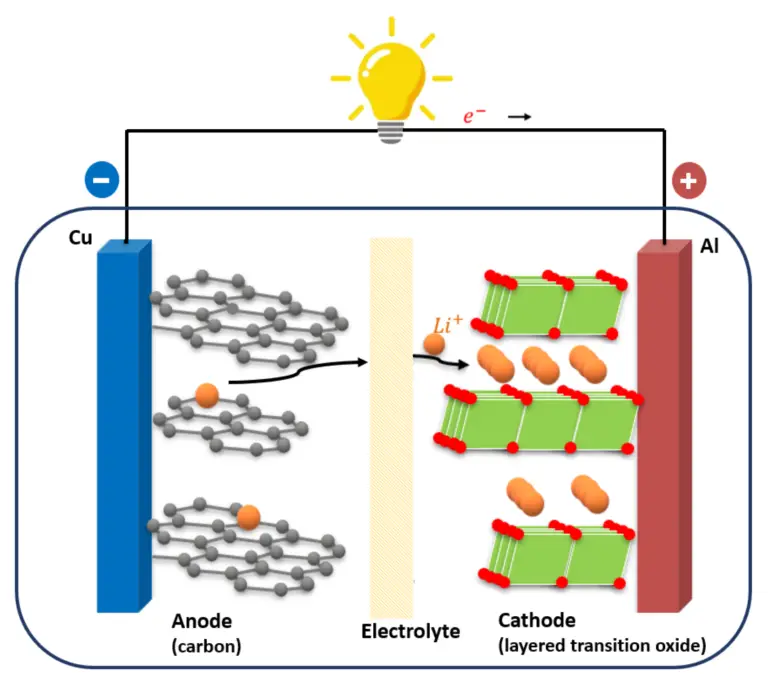
Cathode Material Characteristics
Different Lithium-ion chemistries provide different voltage curves and electrochemical response patterns.
Stable voltage platforms improve SOC estimation consistency under varying load conditions.
LiFePO4 batteries are known for strong safety performance and long cycle life, though their relatively flat voltage profile may increase SOC estimation complexity.
Electrolyte Stability
Electrolyte conductivity affects voltage response speed and internal resistance behavior.
Stable electrolyte systems improve estimation consistency during charging and discharging processes.
Future Development of SOC Estimation Technology
Future Lithium-ion battery SOC estimation technologies will increasingly combine artificial intelligence, cloud computing, and real-time sensor integration.
Advanced battery management systems are expected to provide higher estimation precision, improved thermal prediction capability, and adaptive learning functions for complex operating environments.
At the same time, Na-ion batteries and next-generation solid-state battery technologies are creating new requirements for future SOC estimation models and intelligent energy management systems.