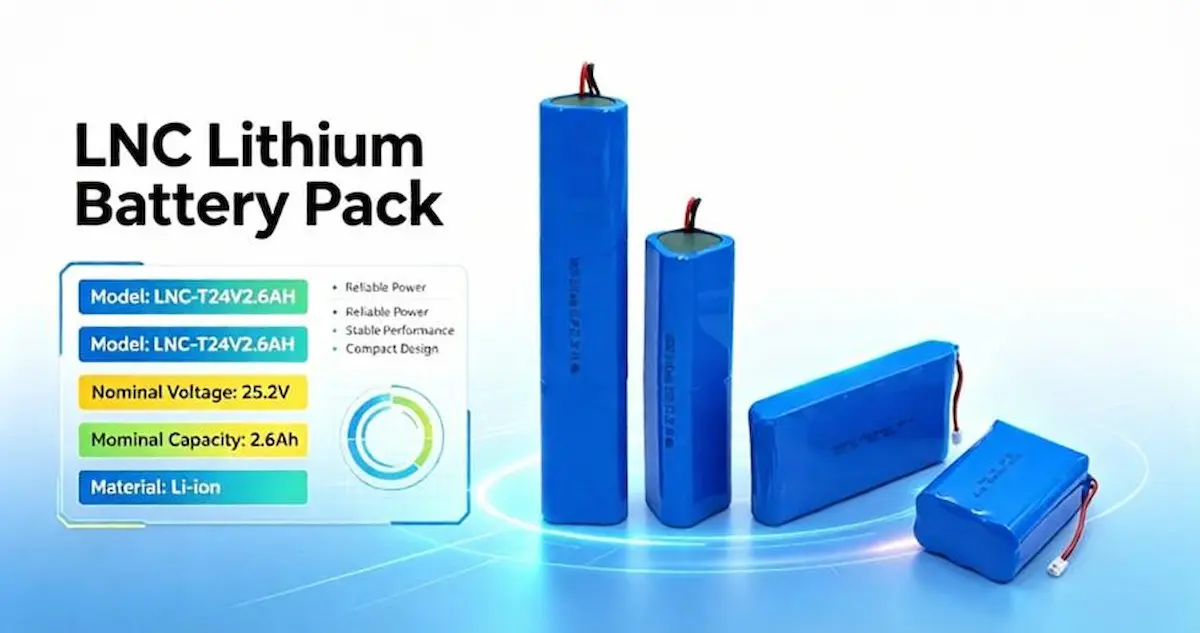
The 24V 2.6Ah 6S1P 18650 Li-ion battery pack is a compact and rechargeable power solution designed for massage guns and other portable equipment that requires stable voltage output, reliable discharge performance, and a space-efficient battery design. Built with 18650 lithium-ion cells and an integrated battery management system (BMS), this battery pack offers dependable power for demanding portable applications.
With a 22.2V nominal voltage, 2.6Ah capacity, and 58Wh rated energy, this 6S1P lithium-ion battery pack provides a practical balance between runtime, size, weight, and output performance. Multiple dimensional configurations are available, making it easier to integrate the battery into different equipment housings.
For more details about this specific battery model, visit the 24V 2.6Ah 6S1P 18650 Li-ion Battery Pack for Massage Guns product page.
24V 2.6Ah 6S1P 18650 Li-ion Battery Specifications
This battery uses an ICR18650-2.6Ah-6S1P cell configuration. The 6S1P arrangement connects six 18650 cells in series, providing the voltage level required by many 24V-class portable devices while maintaining a relatively compact battery structure.
| Item | Specification |
|---|---|
| Model | LNC-T24V2.6AH |
| Battery Type | Rechargeable Li-ion Battery Pack |
| Nominal Voltage | 22.2V |
| Nominal Capacity | 2.6Ah |
| Rated Energy | 58Wh |
| Charging Voltage | 25.2V |
| Operating Voltage Range | 16.8V – 25.2V |
| Standard Charging Current | 0.5C (1.3A) |
| Maximum Charging Current | 1C (2.6A) |
| Standard Discharge Current | 1C (2.6A) |
| Maximum Continuous Discharge Current | 3C (7.8A) |
| Cutoff Discharge Voltage | 16.8V |
| Cell Configuration | ICR18650-2.6Ah-6S1P |
| Cell Type | 18650 Li-ion |
| Connector | PHB-2 Pin |
| Storage Temperature | -20°C to 45°C |
| Charging Temperature | 0°C to 45°C |
| Discharge Temperature | -20°C to 60°C |
Flexible Battery Dimensions for Different Equipment Designs
Battery installation space can vary significantly between massage guns and other portable electronic devices. To support different enclosure designs, this 6S1P 18650 lithium-ion battery pack can be supplied in several dimensional configurations.
| Configuration | External Dimensions |
|---|---|
| Model A | 113 × 19 × 70 mm |
| Model B | 60 × 38 × 70 mm |
| Model C | 37 × 22 × 201 mm |
| Model D | 37 × 39 × 104 mm |
The different configurations provide greater flexibility when the available battery compartment has specific length, width, or thickness limitations. For OEM projects, battery dimensions can also be discussed according to the actual product enclosure and installation requirements.
Why Choose a 6S1P 18650 Li-ion Battery Pack?
Stable Voltage for Portable Equipment
A 6S lithium-ion configuration provides a higher voltage platform than many low-voltage battery packs. With a 22.2V nominal voltage and 25.2V charging voltage, this battery architecture is suitable for portable equipment designed around a 24V-class power system.
The stable voltage profile helps provide consistent power delivery during normal operation, which is particularly useful for battery-powered devices that require reliable motor or electronic performance.
Compact 18650 Cell Configuration
18650 lithium-ion cells are widely used for rechargeable battery packs because they offer a useful combination of energy density, availability, and flexible pack design. The 6S1P configuration uses six cells connected in series, creating a compact battery structure without adding parallel cell groups.
This configuration can help equipment designers balance battery capacity with the available internal space, making it suitable for handheld and portable product designs.
2.6Ah Capacity and 58Wh Energy
With a nominal capacity of 2.6Ah and rated energy of approximately 58Wh, the battery pack provides a practical energy capacity for portable equipment. Actual operating time depends on the power consumption of the connected device, operating conditions, motor load, and battery management settings.
Up to 3C Continuous Discharge Capability
The specified maximum continuous discharge current is 3C, or 7.8A. This provides additional current capability for equipment with higher instantaneous or continuous power requirements, subject to the complete battery system design and application conditions.
Integrated BMS Protection
An integrated Battery Management System (BMS) helps monitor and manage important battery operating conditions. Depending on the configured battery protection system, functions can include protection against overcharging, over-discharging, over-current, short circuits, and abnormal temperature conditions.
Proper BMS configuration is particularly important for rechargeable lithium-ion battery packs because it helps maintain safe operating conditions throughout charging and discharging.
Applications of the 24V 2.6Ah Li-ion Battery Pack
This 24V-class 2.6Ah lithium-ion battery pack is designed for applications that require rechargeable energy storage in a compact form factor. Its voltage, capacity, connector, and dimensional options make it suitable for various portable and battery-powered products.
Massage Guns
The battery is specifically suitable for massage guns and handheld massage equipment that require rechargeable power for motor-driven operation. The compact 6S1P configuration can be integrated into different product housings depending on the available battery compartment.
Portable Electronic Equipment
The battery can also be considered for portable electronic products requiring a higher-voltage rechargeable power source, including handheld equipment, inspection devices, and specialized portable systems.
Industrial and Mobile Equipment
With its 22.2V nominal voltage and configurable battery design, the pack can be adapted for selected industrial devices, mobile equipment, robotics-related products, and other applications where the electrical specifications are compatible.
Customized Battery-Powered Products
For OEM equipment manufacturers and product developers, the battery architecture can be evaluated for applications where voltage, capacity, current output, dimensions, connector type, and BMS functions need to match a specific product design.
Custom 24V Lithium-ion Battery Pack Solutions
Different products often require different battery specifications. A standard battery may not always fit the available installation space or meet the required current and connector configuration. LNC supports customized lithium-ion battery pack solutions based on the requirements of the target application.
Depending on the project, customization may include:
- Battery voltage and capacity
- 18650 cell configuration
- Battery pack dimensions and shape
- Charging and discharge current
- Connector type and cable configuration
- BMS protection parameters
- Battery communication functions where applicable
- Housing and packaging requirements
For projects requiring a specific battery size or electrical configuration, providing the equipment voltage, working current, required runtime, installation space, connector information, and operating environment can help engineers evaluate the appropriate battery design.
Reliable 18650 Li-ion Battery Pack Manufacturing
LNC specializes in rechargeable battery technologies and customized battery pack development for different applications. Its product portfolio covers Li-ion, LiFePO4, Li-polymer, LiMnO2, LiSOCl2, and sodium-ion battery technologies.
For customized battery projects, engineering considerations can include cell selection, pack configuration, electrical protection, mechanical structure, connector selection, and application-specific requirements. This approach helps create battery solutions that are better matched to the actual equipment rather than relying on a one-size-fits-all design.
For customers evaluating this specific battery, the 24V 2.6Ah 6S1P 18650 Li-ion Battery Pack page provides a direct reference for the product and its specifications.
Request a Customized Li-ion Battery Pack
If you are developing a massage gun, portable device, industrial product, or other battery-powered equipment, LNC can evaluate your requirements for a suitable rechargeable lithium-ion battery pack.
When requesting a battery solution, it is helpful to provide the required voltage, capacity, operating current, peak current, expected runtime, available battery space, connector type, and application environment. Based on these requirements, the battery configuration can be evaluated for compatibility with your equipment.
- Custom Voltage and Capacity
- Customized Battery Dimensions
- High-Current Battery Pack Design
- OEM and Customized Battery Support
- 18650 Li-ion Battery Solutions
- Application-Specific BMS Configuration
Frequently Asked Questions About 24V 2.6Ah Li-ion Battery Packs
1. What is the nominal voltage of this 24V lithium-ion battery pack?
The battery pack has a 22.2V nominal voltage and a 25.2V charging voltage. It is commonly described as a 24V-class lithium-ion battery pack because it is designed for equipment using a 24V-class power system.
2. What does 6S1P mean for an 18650 battery pack?
6S1P means that six 18650 lithium-ion cells are connected in series, with one parallel cell group. This configuration increases the battery voltage while maintaining the capacity of the individual cell group.
3. Can this battery pack be customized for a different device?
Yes. Depending on the project requirements, battery voltage, capacity, dimensions, connector, current output, cell configuration, and BMS functions can be evaluated and customized for different equipment designs.
4. What applications can use this 2.6Ah lithium-ion battery?
The battery is designed for applications such as massage guns and other portable equipment. It may also be suitable for selected industrial, mobile, electronic, and battery-powered devices when the electrical and mechanical requirements are compatible.
5. What information is needed for a customized lithium-ion battery pack?
For a customized battery project, it is recommended to provide the required voltage, capacity or runtime, continuous and peak current, battery compartment dimensions, connector requirements, charging method, and application details. These specifications allow the battery design to be evaluated more accurately.