Many customers know lithium batteries as 3.7V batteries, but few understand why this value became the industry standard.
The rated voltage of a lithium-ion battery is not an arbitrary number. It is determined by the electrochemical characteristics of the battery materials, balancing energy density, safety, and cycle life.
1. The Electrochemical Reason Behind 3.7V
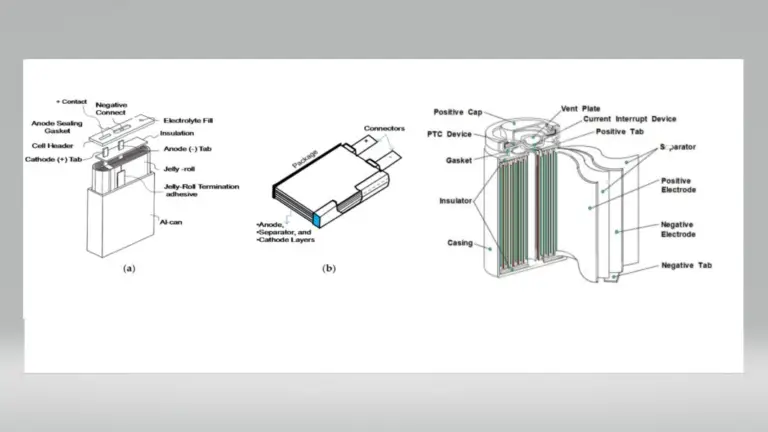
A lithium battery generates voltage from the potential difference between the positive electrode (cathode) and negative electrode (anode).
Taking the common lithium cobalt oxide (LCO) + graphite system as an example:
- The positive electrode operates at a relatively high voltage.
- The graphite negative electrode operates at a low voltage.
- The difference between their electrical potentials creates the battery voltage.
After years of research and optimization, the average working voltage of this system is around 3.7V, which became the standard rated voltage for lithium-ion batteries.
2. Why Not Higher or Lower Voltage?
The voltage range of lithium batteries must stay within a safe window.
For a typical 3.7V lithium-ion battery:
- Fully charged voltage: 4.2V
- Rated voltage: 3.7V
- Cut-off voltage: around 2.8V–3.0V
Too High Voltage
When the voltage exceeds the safe limit:
- The cathode structure may become unstable.
- Electrolyte oxidation increases.
- Heat generation and safety risks may occur.
Too Low Voltage
When the battery is deeply discharged:
- The negative electrode may suffer from lithium deposition.
- Internal resistance increases.
- Battery capacity and cycle life may decrease.
Therefore, 3.7V represents a balance between high energy density and long-term safety.
3. Different Lithium Battery Chemistries Have Different Rated Voltages
Not all lithium batteries are 3.7V. Different cathode materials create different voltage platforms.
| Battery Chemistry | Rated Voltage | Typical Applications |
|---|---|---|
| Lithium Cobalt Oxide (LCO) | 3.7V | Smartphones, laptops, consumer electronics |
| NCM Lithium Battery | 3.6V–3.7V | Electric vehicles, power tools, drones |
| Lithium Iron Phosphate (LiFePO4) | 3.2V | Energy storage, solar systems, EVs |
| Sodium-ion Battery | Around 3.0V | New energy storage applications |
For example:
- A 3.7V lithium-ion cell usually has a higher energy density.
- A 3.2V LiFePO4 cell provides better safety and longer cycle life.
4. Why Did 3.7V Become an Industry Standard?
The 3.7V rating became widely used after the commercialization of lithium-ion batteries in the 1990s.
As lithium batteries became popular in portable electronics, manufacturers developed standardized designs around this voltage, including:
- Battery protection circuits (PCM/BMS)
- Charging ICs
- Power management systems
- Battery pack configurations
For battery packs, the calculation is also simple:
- 2S battery pack: 3.7V × 2 = 7.4V
- 3S battery pack: 3.7V × 3 = 11.1V
- 4S battery pack: 3.7V × 4 = 14.8V
This standardization greatly simplified battery design and application development.
5. Will Future Batteries Exceed 3.7V?
Battery technology continues to evolve.
New materials such as:
- High-voltage cathode materials
- Silicon-based anodes
- Solid-state battery technology
are being developed to achieve higher voltage and higher energy density.
However, improving voltage is not only about increasing the number. Higher voltage batteries must also solve challenges related to:
- Material stability
- Electrolyte compatibility
- Safety performance
- Manufacturing cost
Conclusion
The 3.7V lithium battery standard is the result of decades of optimization between chemistry, safety, and engineering requirements.
It represents the best balance achieved by traditional lithium-ion technology between:
- Energy density
- Battery life
- Safety
- Commercial compatibility
Although future battery technologies may introduce higher voltage platforms, 3.7V lithium batteries will continue to play an important role in consumer electronics, industrial equipment, and custom battery solutions.