
The retention rate of the full charge storage capacity of lithium-ion batteries
Lithium-Ion Battery Capacity Retention at Full Charge Storage: Why 100% SOC Is the Worst Place to Park Your Cells
If you have ever left a device plugged in overnight — or worse, left it on the charger for weeks — you already know the answer feels wrong. The battery dies faster. But the reason most people give (“overcharging damaged it”) is not quite right. The real culprit is something slower and more insidious: storing a lithium-ion cell at 100% state of charge accelerates chemical degradation even when the battery is doing absolutely nothing.
This is one of the most counterintuitive facts in battery science. You would think a fully charged battery sitting idle is perfectly happy. It is not. It is slowly falling apart from the inside.
What Happens to a Cell Sitting at 100% SOC
When a lithium-ion cell is held at full charge, the cathode is fully lithiated and the anode is nearly empty of lithium ions. This is a high-energy, high-stress configuration. Even with zero current flowing, side reactions continue — and they are brutal at this voltage.
The SEI layer on the anode keeps growing. This is the thin film that forms during the first few cycles and normally stabilizes. But at high voltage, the electrolyte keeps decomposing at the anode surface, thickening the SEI layer continuously. Every nanometer of extra SEI consumes active lithium irreversibly. That lithium is gone forever. It does not cycle back. It just sits trapped in the film.
At the cathode, the metal oxide structure is under mechanical stress. The crystal lattice is expanded because it is stuffed with lithium ions. Over weeks and months, this causes micro-cracks. Cracks expose fresh surface to the electrolyte, which triggers more decomposition, more SEI growth, more lithium loss. It is a slow cascade.
The result is measurable capacity loss — even with the cell never leaving the shelf.
How Much Capacity Do You Actually Lose
The numbers vary by chemistry, temperature, and storage duration, but the pattern is consistent across almost every study.
At 25°C, an NMC cell stored at 100% SOC loses roughly 3% to 5% of its capacity in the first month. After six months, that climbs to 8% to 15%. After a year, you are looking at 15% to 25% capacity loss — and the cell has never been used once.
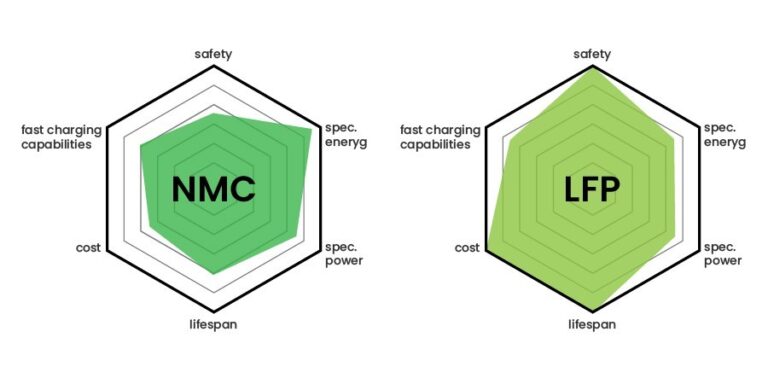
LFP handles this better. Its flat voltage curve means less stress on the cathode at full charge. At the same 25°C and 100% SOC, LFP might lose only 2% to 4% in six months. But it is not immune. The SEI still grows, and lithium still gets trapped.
Temperature makes everything worse. At 40°C, an NMC cell at 100% SOC can lose 35% of its capacity in just six months. At 60°C, the same cell might be unusable in three months. The Arrhenius relationship applies here — roughly every 10°C increase doubles the degradation rate.
This is why a battery left in a hot car over summer can arrive at 70% capacity even though nobody touched it. The heat plus the full charge is a one-two punch that the cell cannot survive.
The Voltage Connection: Why 4.2V Is the Danger Zone
For NMC cells, 100% SOC means the cell sits at 4.2V or slightly above. That voltage is right at the edge of electrolyte stability. Most carbonate-based electrolytes begin to oxidize above 4.1V to 4.3V depending on the specific formulation. Oxidation produces gas, increases internal pressure, and generates acidic byproducts that attack every component inside the cell.
LFP sits at 3.6V when fully charged, which is well below the electrolyte oxidation threshold. This is a big reason why LFP degrades so much more slowly in storage. The voltage itself is the protective factor.
Why 40% to 60% SOC Is the Sweet Spot for Storage
If 100% is the worst and 0% is also bad (copper dissolution, anode collapse), then the middle must be best. And it is.
Research from multiple independent labs converges on 40% to 60% SOC as the optimal storage window. At this range, the cathode is not over-stressed, the anode is not over-empty, and the voltage sits low enough to suppress most parasitic reactions.
An NMC cell stored at 50% SOC and 25°C loses less than 2% capacity over six months. Over a full year, the loss stays under 5%. Compare that to 15% to 25% at 100% SOC, and the difference is staggering.
LFP stored at 50% SOC shows almost negligible loss — typically under 1% per year at room temperature. This is why LFP packs sitting in warehouses for months come out nearly ready to use.
The Real-World Impact on Different Applications
Consumer Electronics Sitting on Shelves
A phone or laptop that ships from the factory at 50% to 60% SOC and sits in a warehouse for six months will arrive with nearly full capacity. But if the same device is stored at 100% SOC — which some retail displays do — it arrives already degraded. The buyer blames the manufacturer. The real cause was the storage protocol.
This is why reputable manufacturers ship devices at partial charge, not full. It is not about saving shipping cost. It is about making sure the battery you open still has its rated capacity.
Electric Vehicle Packs Parked for Weeks
An EV left plugged in at 100% for a two-week vacation will come back with measurably less range than when you left. The BMS might not show it immediately because it still reads voltage, not true capacity. But the first few drives will reveal a shorter range than expected.
The fix is simple: set the charge limit to 50% or 60% before parking. Most modern EVs let you do this from the app. A pack stored at 60% SOC for two weeks loses almost nothing. The same pack at 100% loses 1% to 3% — and if it was hot during those two weeks, the loss could be double that.
Stationary Energy Storage Systems
Grid storage batteries often sit idle for days or weeks between charge cycles. If these packs are kept at 100% SOC during standby, their usable life drops significantly. Operators who enforce a 40% to 60% storage window report pack lifespans extending by 30% to 50% compared to packs kept topped off.
The economic impact is real. A storage system that degrades 2% per year instead of 8% per year delivers more total energy throughput over its lifetime — sometimes enough to change the entire project economics.
What You Can Do Right Now
If you own any lithium-ion device, the single best thing you can do for long-term capacity is stop keeping it at 100%.
Enable the optimized charging feature on your phone. It learns your routine and holds the charge at 80% overnight, topping off only before you wake up. That alone cuts storage degradation in half.
For laptops, unplug the charger once it hits 80% if you are not using it immediately. Do not leave it plugged in for days.
For EVs, set a weekly charge limit if you commute on a predictable schedule. Let the pack sit at 50% to 60% most of the time. Use 100% only when you need the full range.
Store spare batteries in a cool, dry place at around 50% charge. Not in a hot garage. Not in direct sunlight. Not at 100%. A sealed container at room temperature is all you need.
The capacity you save today is the capacity you will have two years from now. Full charge feels safe. It is actually the fastest way to kill a battery while it sleeps.