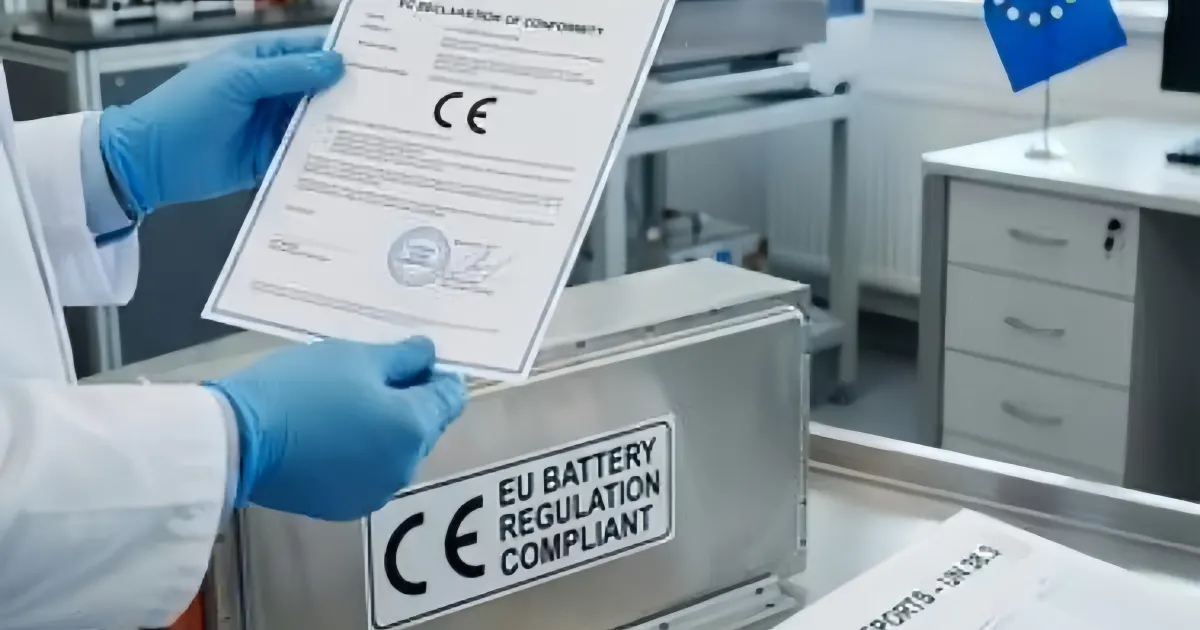
When exporting lithium batteries to the European market, suppliers need to meet applicable safety, environmental, and regulatory requirements.
The required compliance documents and certifications depend on:
- Battery type
- Application
- Voltage and capacity
- Final product design
Common requirements for lithium battery products include:
- CE marking (where applicable)
- EMC compliance
- RoHS compliance
- Battery safety standards
- UN38.3 transportation test report
- MSDS and technical documentation
What Is CE Marking for Lithium Batteries?
CE marking indicates that a product complies with applicable European Union requirements related to safety, health, and environmental protection.
For lithium batteries, the applicable regulations depend on the product category and application.
Before placing products on the EU market, manufacturers need to prepare technical documentation, complete required compliance assessments, and issue a Declaration of Conformity (DoC) when applicable.
Main Compliance Requirements for Lithium Batteries in Europe
1. EMC (Electromagnetic Compatibility)
EMC requirements ensure that battery systems can operate reliably without causing unacceptable electromagnetic interference.
EMC is especially important for:
- Battery packs with BMS
- Smart battery systems
- Industrial battery solutions
- Energy storage systems
Common EMC-related requirements include:
- Electromagnetic emission testing
- Electromagnetic immunity testing
Proper EMC design helps improve system reliability and prevent communication or control issues.
2. RoHS Environmental Compliance
RoHS restricts the use of hazardous substances in electrical and electronic products.
Lithium battery products and related electronic components may need to comply with restrictions on substances such as:
- Lead
- Mercury
- Cadmium
- Hexavalent chromium
RoHS compliance is commonly requested by European customers and distributors.
3. Lithium Battery Safety Standards
Different battery applications require different safety standards.
IEC 62133-2
IEC 62133-2 is commonly used for rechargeable lithium-ion batteries in portable applications.
Typical applications include:
- Portable electronic devices
- Small battery packs
- Consumer products
The standard evaluates battery safety performance, including:
- Overcharge protection
- External short circuit
- Mechanical stress
- Thermal safety
IEC 62619
IEC 62619 is mainly used for industrial lithium battery systems.
Typical applications include:
- Energy storage systems
- Communication backup batteries
- Industrial equipment
- AGV and robotics batteries
The standard focuses on:
- Battery system safety
- Battery Management System (BMS) protection
- Thermal safety
- Long-term reliability
Required Documents for Lithium Battery Export to Europe
UN38.3 Test Report
UN38.3 is required for lithium battery transportation safety.
The testing evaluates battery safety under transportation conditions, including:
- Altitude simulation
- Temperature changes
- Vibration
- Shock
- External short circuit
- Overcharge and forced discharge
Common shipping classifications include:
- UN3480: Lithium-ion batteries shipped separately
- UN3481: Lithium-ion batteries packed with or installed in equipment
MSDS (Material Safety Data Sheet)
MSDS provides important information about:
- Battery composition
- Handling requirements
- Transportation safety
- Emergency response
It is commonly required for battery shipment and customer review.
Technical Documentation
Battery suppliers may need to provide technical documents, including:
- Product specifications
- Test reports
- Compliance documents
- Risk assessment information
- Declaration of Conformity (DoC)
EU Battery Regulation (EU) 2023/1542
Besides CE-related requirements, lithium battery products entering the European market are also affected by the EU Battery Regulation.
The regulation introduces additional requirements related to:
- Battery sustainability
- Carbon footprint information
- Recycling requirements
- Battery lifecycle management
- Digital battery passport for applicable battery categories
Battery suppliers should understand these requirements when developing products for the European market.
How to Prepare Lithium Batteries for the EU Market?
Before exporting lithium batteries to Europe, suppliers should confirm:
✓ Applicable battery safety standards
✓ UN38.3 transportation compliance
✓ EMC requirements (if applicable)
✓ RoHS compliance
✓ Required technical documentation
✓ Customer-specific certification requirements
The exact requirements depend on the battery application, product structure, and end market.
Conclusion
CE compliance and related safety requirements are important considerations when exporting lithium batteries to Europe.
For lithium battery cells, LiFePO4 battery packs, industrial batteries, and energy storage systems, selecting the correct standards and preparing complete documentation helps ensure reliable product acceptance in the global market.
LNC Batteries provides custom lithium battery packs, LiFePO4 battery solutions, and OEM battery services for industrial, commercial, and energy storage applications.