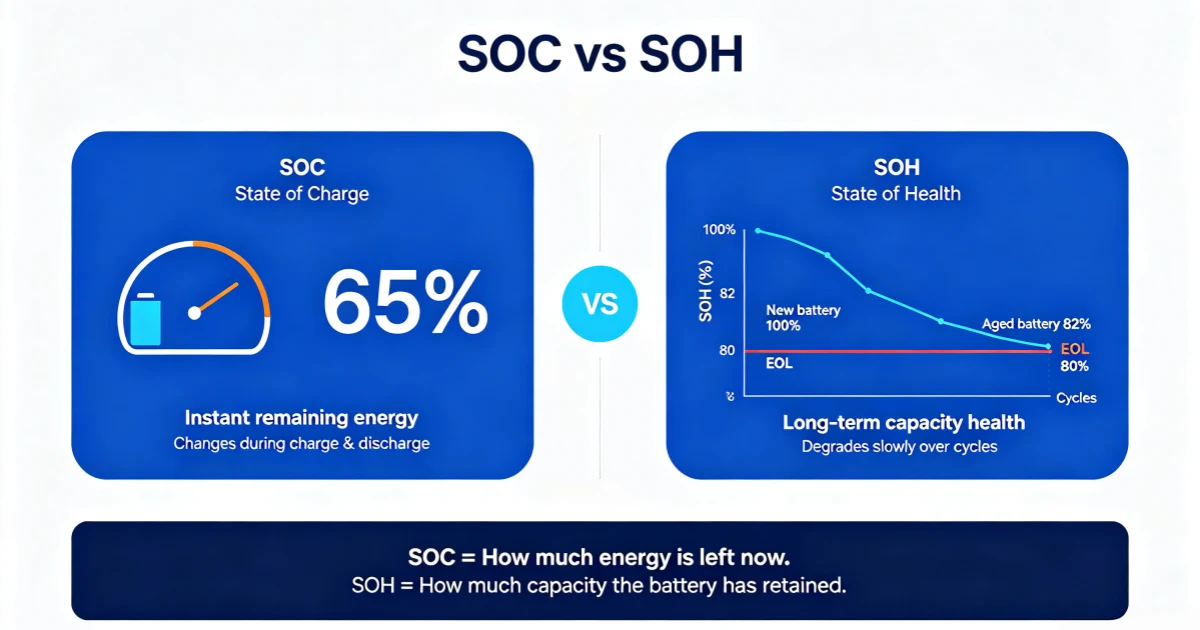
SOC is often described as a battery’s real-time state of charge, while SOH represents its long-term health condition. These two concepts are easy to understand, but they are much more important than simple percentage readings.
As energy storage systems become increasingly involved in energy trading, frequency regulation, capacity services, and demand response, accurate SOC and SOH estimation is becoming more important for both battery safety and system performance.
For an energy storage system, inaccurate SOC can contribute to overcharging, over-discharging, inefficient dispatch, and lost operating opportunities. Poor SOH estimation can lead to inaccurate lifetime predictions, capacity degradation assessments, and asset valuation.
1. What Is SOC?
SOC (State of Charge) indicates how much usable energy remains in a battery compared with its available capacity.
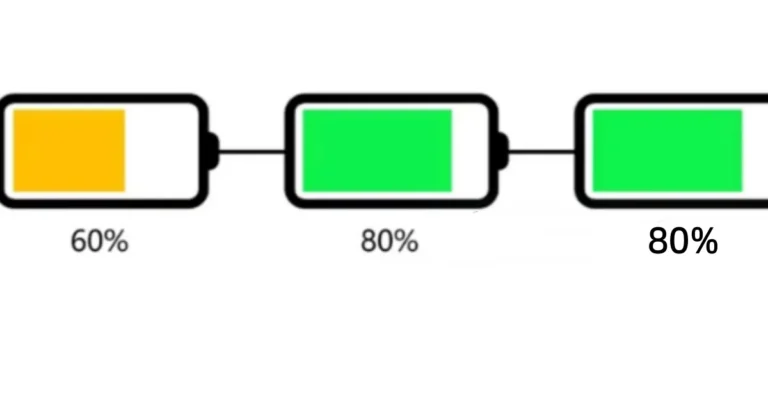
For example, if an energy storage system shows an SOC of 60%, it generally means that approximately 60% of its usable energy capacity remains available under the defined operating conditions.
For an EMS (Energy Management System), SOC is one of the key parameters used to determine charging and discharging strategies.
For grid-connected energy storage, SOC can be viewed as the system’s available energy margin.
When a system is required to perform peak shaving, load shifting, frequency regulation, or emergency support, the operator needs to know:
- How much energy can still be discharged?
- How much additional energy can be charged?
- Is the battery close to its operating limits?
- Can the system respond to the next dispatch command?
In simple terms, SOC answers the question: “How much can the battery do right now?”
2. What Is a Suitable SOC Operating Range?
Energy storage systems generally do not operate continuously from 0% to 100% SOC. The EMS usually defines upper and lower SOC limits to balance usable energy, safety, and battery lifetime.
A 10%–90% SOC range is often used as a practical reference, but it is not a universal requirement.
Keeping a battery at a very high SOC for extended periods can accelerate certain aging mechanisms, while deep discharge can also increase degradation and reduce usable lifetime.
The optimal SOC window depends on the battery chemistry, cell design, operating temperature, C-rate, required cycle life, and project economics.
A wider SOC range provides more usable energy for each cycle, but may increase degradation stress. A narrower range can be more favorable for battery longevity, but reduces the energy available for operation and trading.
For this reason, mature energy storage operating strategies may adjust SOC limits according to market requirements, temperature, battery condition, and expected cycling demand.
3. What Is SOH?
SOH (State of Health) describes the aging condition of a battery compared with its original or reference condition.
A new battery is generally considered to have an SOH of approximately 100%. As the battery ages, SOH gradually decreases.
The key difference is:
- SOC: How much energy is available now?
- SOH: How much performance and usable capacity does the battery retain?
One commonly used capacity-based definition is:
SOH = Current Maximum Available Capacity / Initial Rated Capacity × 100%
For example, if a battery’s available capacity has declined to 80% of its initial reference capacity, its capacity-based SOH would be approximately 80%.
However, capacity is not the only parameter relevant to battery health.
Internal Resistance Also Matters
Battery aging is often accompanied by increasing internal resistance.
Higher internal resistance can result in:
- Higher voltage drop during high-current operation
- Increased heat generation
- Lower charging and discharging efficiency
- Reduced high-rate power capability
- Reduced performance in applications requiring rapid response
Therefore, more advanced SOH estimation methods may consider multiple indicators, including capacity, internal resistance, power capability, and other aging-related parameters.
SOH should therefore not always be interpreted as a single measurement. Its exact definition depends on the battery system, application, and evaluation method.
4. Why Does SOH Decrease?
Battery aging is affected by multiple factors. Four of the most important are cycle aging, temperature, C-rate, and calendar aging.
1. Cycle Aging
Every charge and discharge cycle causes gradual physical and electrochemical changes inside the cell.
The actual degradation rate depends on factors such as depth of discharge (DOD), charging voltage, C-rate, temperature, and cell chemistry.
2. Temperature
Temperature has a significant effect on battery aging.
High temperatures can accelerate unwanted side reactions and material degradation. Low temperatures can reduce lithium-ion transport and, under inappropriate charging conditions, increase the risk of lithium plating.
This is why thermal management systems are an important part of large-scale energy storage systems.
3. Charge and Discharge Rate
High C-rates mean higher charging or discharging currents.
High-current operation can increase polarization and heat generation and may accelerate degradation when sustained over long periods.
For applications such as frequency regulation and fast-response power support, both battery power capability and long-term aging need to be considered.
4. Calendar Aging
A battery can age even when it is not actively cycling.
Chemical reactions inside the cell continue over time, and storage conditions such as temperature and SOC can significantly affect calendar aging.
This is one reason why battery storage conditions and manufacturing date can be important when evaluating cells for large energy storage projects.
5. Does 80% SOH Mean the Battery Must Be Retired?
Not necessarily.
An SOH of 80% is often used as a reference point when discussing battery end of life, particularly for capacity-based evaluations. However, it should not be treated as a universal retirement threshold for every energy storage application.
Whether a battery should continue operating depends on:
- Remaining usable capacity
- Internal resistance
- Power capability
- Safety condition
- Cell-to-cell consistency
- Operating requirements
- Economic considerations
- Applicable standards and project specifications
A battery with reduced capacity may still be suitable for applications with lower power or energy requirements.
For large-scale energy storage projects, however, project owners and system integrators may impose stricter requirements for new batteries, consistency, traceability, safety, and expected lifetime.
Therefore, SOH should be evaluated together with the actual application requirements rather than using a single percentage as the only retirement criterion.
6. How Are SOC and SOH Used in Battery Operations?
SOC and SOH have different roles in energy storage system management.
SOC: Short-Term Operating Indicator
SOC is primarily used for real-time control.
It helps the EMS determine:
- How much energy can be charged or discharged
- Whether the battery is approaching its operating limits
- Whether the system can respond to a dispatch command
- How much energy reserve is available
In simple terms, SOC answers:
“What can the battery do now?”
SOH: Long-Term Health Indicator
SOH is more relevant to long-term battery management.
It helps operators evaluate:
- Capacity degradation
- Battery aging
- Remaining useful life
- Maintenance and replacement requirements
- Long-term system performance
- Asset value and operating economics
SOH answers:
“How much useful performance does the battery have left?”
7. SOC and SOH Work Together
SOC and SOH should not be considered independent numbers.
A battery may show 80% SOC while having only 85% of its original capacity. In this case, the SOC describes the battery’s current state, while the SOH describes the battery’s long-term degradation condition.
For an energy storage system, the two indicators work together:
SOC → Real-time operating state
SOH → Long-term health condition
Accurate SOC supports safe and efficient dispatch, while reliable SOH estimation supports maintenance, lifetime planning, and asset management.
Together, they provide a more complete picture of the battery’s current operating capability and long-term condition.
Key Takeaways
- SOC (State of Charge) indicates the battery’s current available charge or energy state.
- SOH (State of Health) describes how much performance the battery retains compared with its reference condition.
- SOC is mainly a real-time operating parameter, while SOH is a long-term aging parameter.
- SOC operating limits should be selected according to battery chemistry, temperature, C-rate, lifetime requirements, and project economics.
- SOH should not be determined by capacity alone; internal resistance and power capability can also be important.
- An 80% SOH value is commonly used as an end-of-life reference in some contexts, but it is not a universal retirement rule.
- Reliable SOC and SOH estimation is important for battery safety, system efficiency, maintenance planning, and energy storage asset management.
For customized LiFePO4 battery packs, energy storage batteries, and battery solutions, LNC can support cell selection, battery pack design, BMS configuration, and OEM/ODM requirements.