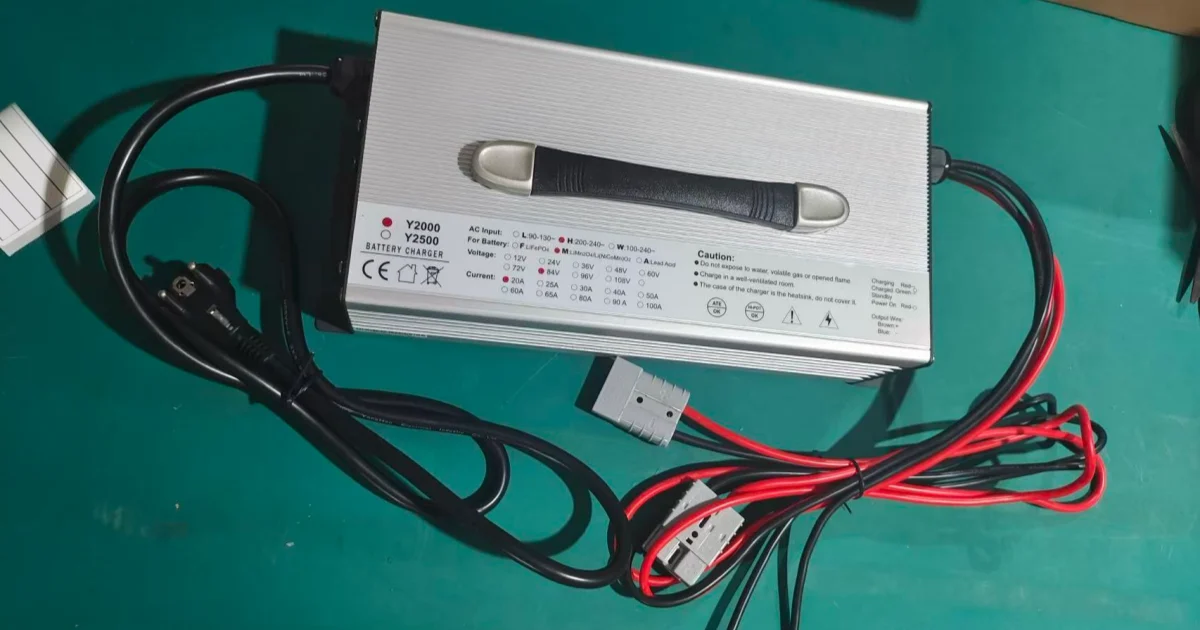
Choosing the correct lithium battery charger is just as important as selecting high-quality battery cells.
Many battery failures are not caused by the battery itself, but by using an incorrect charger, improper charging voltage, or unsuitable charging current.
A properly matched charger can improve charging efficiency, reduce heat generation, and extend battery cycle life.
This article explains the key parameters of lithium battery chargers, CC/CV charging principles, charging speed effects, charging standards for different lithium battery chemistries, and common charging problems.
1. Understanding Lithium Battery Charger Parameters
When selecting a lithium battery charger, the most important factors include output voltage, charging current, connector type, and charger quality.
The charger must match:
- Battery chemistry
- Number of cells in series (S)
- Battery capacity
- Maximum charging current
- BMS protection requirements
1.1 Output Voltage: Match the Battery Series Configuration
The output voltage of a lithium battery charger is determined by the battery chemistry and the number of cells connected in series.
The charger voltage must match the battery pack’s full charge voltage.
Using an incorrect charger voltage may cause:
- Overcharging
- Battery swelling
- BMS protection failure
- Reduced battery lifespan
- Safety risks
Lithium Battery Charger Voltage Matching Table
| Battery Chemistry | Nominal Voltage (Per Cell) | Full Charge Voltage (Per Cell) | Charging Voltage Examples |
|---|---|---|---|
| NCM / NCA Lithium Battery | 3.7V | 4.2V | 13S = 54.6V 17S = 71.4V 20S = 84V |
| LiFePO4 Battery | 3.2V | 3.65V | 16S = 58.4V 20S = 73V 24S = 87.6V |
| Lithium Titanate (LTO) Battery | Around 2.4V | Around 2.8V | Depends on battery configuration |
For example:
A “48V lithium battery” does not always use the same charger.
- 13S NCM battery:
- Full charge voltage: 54.6V
- 16S LiFePO4 battery:
- Full charge voltage: 58.4V
Although both are called “48V”, their chargers are different.
1.2 Charging Current: Faster Charging Does Not Always Mean Better
Charging current determines how quickly a battery can be charged.
The charging rate is usually measured by C-rate.
- 1C means the battery can theoretically be fully charged in 1 hour.
- 0.5C means approximately 2 hours.
- 0.2C means approximately 5 hours.
The charging current calculation:
Charging Current (A) = Battery Capacity (Ah) × C-rate
Example: For a 20Ah battery:
- 0.5C charging: 20Ah × 0.5 = 10A charging current
Charging Rate Comparison Table
| Charging Rate | Approximate Charging Time | Battery Impact | Recommended Applications |
|---|---|---|---|
| 0.2C | About 5 hours | Lowest heat generation, best for lifespan | Energy storage, backup power |
| 0.5C | About 2 hours | Good balance between speed and lifespan | Most lithium battery applications |
| 1C | About 1 hour | Higher temperature and faster aging | Fast charging applications |
| Above 1C | Less than 1 hour | Higher stress, faster degradation | Special high-power applications |
For most lithium battery systems, 0.2C-0.5C charging is recommended because it provides a good balance between charging speed and battery lifespan.
1.3 Charging Connector and Polarity
The charger connector must match the battery pack.
Before charging, always check:
- Positive and negative polarity
- Connector type
- Charging port configuration
Incorrect polarity may damage:
- Charger circuit
- Battery protection board (BMS/PCM)
- Battery pack components
Common lithium battery charging connectors include:
| Connector Type | Common Applications |
|---|---|
| XT60 / XT90 | Power tools, RC, high-current battery packs |
| Aviation Connector | Industrial equipment and battery packs |
| XLR Connector | Portable devices and professional equipment |
| DC Connector | Consumer electronic devices |
For battery packs with separate charging and discharging ports:
- Charging port → Connect only to charger
- Discharging port → Connect only to load equipment
1.4 How to Identify a Quality Lithium Battery Charger
A reliable charger should have:
Safety Certifications
Choose chargers with proper safety certifications and protection functions instead of low-cost untested products.
Accurate CC/CV Control
A quality lithium battery charger should provide:
- Constant Current (CC) charging
- Constant Voltage (CV) charging
- Over-voltage protection
- Over-current protection
- Short-circuit protection
Good Thermal Management
High-power chargers should include:
- Cooling fans
- Temperature protection
- Stable output control
Good heat dissipation helps maintain charging safety and charger reliability.
2. How CC/CV Charging Works for Lithium Batteries
Lithium batteries cannot be charged safely by simply applying a constant high current until they are full.
A standard lithium battery charging process consists of two stages:
- Constant Current (CC) charging
- Constant Voltage (CV) charging
This charging method improves charging efficiency while reducing battery stress.
2.1 Constant Current (CC) Charging Stage
During the CC charging stage:
- The charger provides a constant charging current.
- Battery voltage gradually increases.
- Most of the battery capacity is charged during this stage.
Usually, approximately 70%-80% of the battery capacity is charged during the CC stage.
Characteristics:
| Parameter | CC Charging Stage |
|---|---|
| Charging Current | Constant |
| Battery Voltage | Gradually increases |
| Charging Speed | Fast |
| Heat Generation | Higher than CV stage |
| Main Function | Quickly restore battery capacity |
2.2 Constant Voltage (CV) Charging Stage
When the battery reaches its maximum charging voltage:
- NCM/NCA battery: 4.2V per cell
- LiFePO4 battery: 3.65V per cell
The charger switches to constant voltage mode.
During this stage:
- Voltage remains stable.
- Charging current gradually decreases.
- The battery reaches full capacity safely.
CC/CV Charging Process Comparison
| Charging Stage | Voltage | Current | Battery Status |
|---|---|---|---|
| Constant Current (CC) | Gradually increases | Remains constant | Fast charging stage, reaches most capacity |
| Constant Voltage (CV) | Remains constant | Gradually decreases | Final charging stage, completes charging |
When the charging current drops to the preset ending value (usually around 0.05C), charging is completed.
3. Fast Charging vs Slow Charging: Impact on Battery Lifespan
Charging speed directly affects battery temperature, chemical stress, and cycle life.
A faster charger is not always better.
3.1 Slow Charging (0.2C-0.5C)
Slow charging is the most battery-friendly charging method.
Advantages:
- Lower heat generation
- Less chemical stress
- Longer cycle life
- Better long-term performance
Disadvantages:
- Longer charging time
Suitable applications:
- Solar energy storage
- Backup power systems
- Overnight charging
- Long-term standby devices
3.2 Fast Charging (0.5C-1C)
Fast charging provides a good balance between charging speed and battery life.
Advantages:
- Shorter charging time
- Suitable for applications requiring quick energy recovery
Disadvantages:
- Higher charging temperature
- Increased battery aging compared with slow charging
Suitable applications:
- Electric tools
- Electric vehicles
- Equipment requiring frequent charging
3.3 Ultra-Fast Charging (Above 1C)
Ultra-fast charging can significantly reduce charging time, but it creates more stress on battery cells.
Advantages:
- Very short charging time
Disadvantages:
- Higher heat generation
- Increased lithium plating risk
- Faster capacity degradation
- Reduced cycle life
It should only be used when fast charging is a necessary requirement.
4. Lithium Battery Charging Standards by Chemistry
Different lithium battery chemistries require different charging parameters.
Using the wrong charger can cause charging failure or safety problems.
4.1 NCM / NCA Lithium Battery Charging Requirements
NCM and NCA batteries provide high energy density but require accurate voltage control.
| Parameter | Standard |
|---|---|
| Nominal Voltage | 3.7V per cell |
| Charge Cut-off Voltage | 4.20V ± 0.05V per cell |
| Recommended Charging Rate | 0.2C-0.5C |
| Maximum Charging Rate | Usually ≤1C |
| Charging Temperature | 0°C to 45°C |
Characteristics:
- High energy density
- Strong power output
- Sensitive to overcharging
- Requires accurate BMS protection
4.2 LiFePO4 Battery Charging Requirements
LiFePO4 batteries are widely used in energy storage and industrial applications due to their excellent safety and long cycle life.
| Parameter | Standard |
|---|---|
| Nominal Voltage | 3.2V per cell |
| Charge Cut-off Voltage | 3.65V ± 0.05V per cell |
| Recommended Charging Rate | 0.2C-0.5C |
| Maximum Charging Rate | Depends on cell type |
| Charging Temperature | -10°C to 55°C |
Characteristics:
- Excellent safety
- Long cycle life
- Good high-temperature performance
- Lower energy density compared with NCM
4.3 Lithium Titanate (LTO) Battery Charging Requirements
LTO batteries are designed for applications requiring extremely long cycle life and fast charging capability.
| Parameter | Standard |
|---|---|
| Nominal Voltage | Around 2.4V per cell |
| Charge Cut-off Voltage | Around 2.8V per cell |
| Charging Rate | High-rate charging supported |
| Cycle Life | Extremely long |
| Main Applications | Special high-performance systems |
Characteristics:
- Excellent fast charging capability
- Very long cycle life
- High cost
- Lower energy density
5. Common Lithium Battery Charging Problems and Solutions
Incorrect chargers, aging cells, or improper charging conditions can cause various charging problems.
| Problem | Possible Causes |
|---|---|
| Charger turns green immediately and battery does not charge | Battery already full, incorrect charger voltage, charging circuit failure, BMS protection activated |
| Charger remains red for a long time | Charging current too low, battery aging, cell imbalance, high self-discharge |
| Battery becomes very hot during charging | Excessive charging current, high internal resistance, poor connection, high temperature environment |
| Battery voltage drops quickly after charging | Cell imbalance, high self-discharge, incomplete charging, BMS power consumption |
5.1 Charger Turns Green Immediately
Possible reasons:
- Battery voltage has already reached the full charge level.
- Charger output voltage does not match the battery.
- Charging cable or connector is disconnected.
- BMS has activated protection.
- Charging MOSFET has failed.
5.2 Charger Remains Red for a Long Time
Possible reasons:
- Charger current is too low for the battery capacity.
- Battery cells have high self-discharge.
- Cell imbalance causes long balancing time.
- Battery aging increases charging difficulty.
5.3 Battery Gets Hot During Charging
Possible reasons:
- Charging current exceeds the battery specification.
- Internal resistance is too high.
- Welding points or connectors have high resistance.
- Ambient temperature is too high.
- Battery cells are aging.
5.4 Battery Voltage Drops Quickly After Full Charge
Possible reasons:
- Battery is not fully charged due to charger mismatch.
- Cells have high self-discharge.
- Battery pack imbalance.
- BMS standby power consumption is too high.
6. Common Lithium Battery Charging Mistakes
Mistake 1: Higher Charging Current Is Always Better
Reality:
A higher charging current reduces charging time, but it also increases heat generation and chemical stress.
For daily use, 0.5C or lower charging is usually recommended to achieve a better balance between charging speed and battery lifespan.
Mistake 2: New Lithium Batteries Need 12-Hour Activation Charging
Reality:
Modern lithium batteries do not have a memory effect.
Battery cells are already activated during manufacturing. Normal charging is sufficient.
Long-time overcharging may damage the battery.
Mistake 3: All 48V Lithium Batteries Use the Same Charger
Reality:
The term “48V” only describes the nominal voltage.
Different battery chemistries have different charging voltages:
| Battery Type | Configuration | Full Charge Voltage |
|---|---|---|
| NCM Lithium Battery | 13S | 54.6V |
| LiFePO4 Battery | 16S | 58.4V |
A charger must match both:
- Battery chemistry
- Series configuration
Mistake 4: Leaving Batteries Connected to the Charger Permanently
Reality:
Long-term storage at high voltage accelerates battery aging.
For better battery health:
- Disconnect the charger after charging is complete.
- Avoid storing batteries at 100% charge for long periods.
- Keep batteries in a suitable temperature environment.
Conclusion
Choosing the right lithium battery charger is essential for battery safety, performance, and service life.
The charger voltage, charging current, charging method, and battery chemistry must always match the battery requirements.
A properly selected charger can:
- Reduce heat generation
- Improve charging efficiency
- Extend battery cycle life
- Improve overall battery reliability
At LNC Battery, we provide lithium battery cells and customized battery pack solutions with professional support for battery selection, charging requirements, BMS matching, and application design.
Whether you need cylindrical lithium cells, LiFePO4 batteries, or custom battery packs, our team can help develop a reliable power solution for your application.