When testing lithium battery cells, you may find that the same cell shows different internal resistance values depending on the test method. For example, an ACIR measurement may show 18 mΩ while a DCIR test gives 22 mΩ.
So, which value is correct?
In most cases, neither measurement is necessarily wrong. ACIR and DCIR use different test methods and observe the battery over different time scales.
1. What Is Battery Internal Resistance?
Battery internal resistance is more than a simple resistance value.
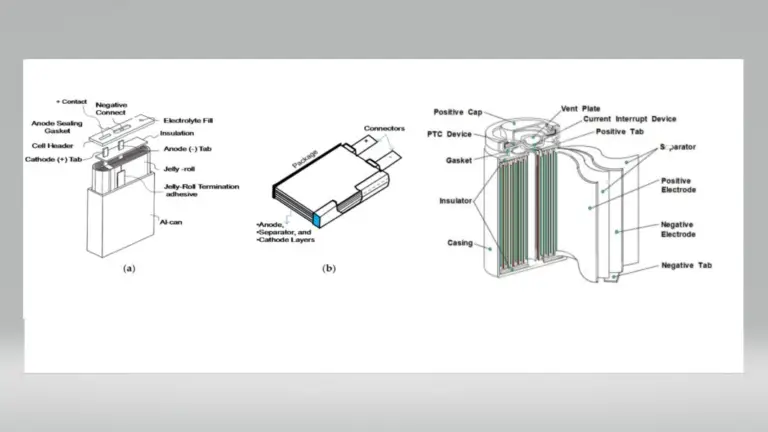
The internal impedance of a lithium-ion cell can generally be understood through several major components:
- Ohmic resistance: Related to ionic conduction in the electrolyte, current collectors, tabs, welds, and other conductive paths.
- Charge-transfer resistance: The resistance associated with electrochemical charge-transfer reactions at the electrode interface.
- Diffusion impedance: The resistance to ion transport through the porous electrode structure, often associated with Warburg impedance.
These components respond differently depending on the frequency and time scale of the test.
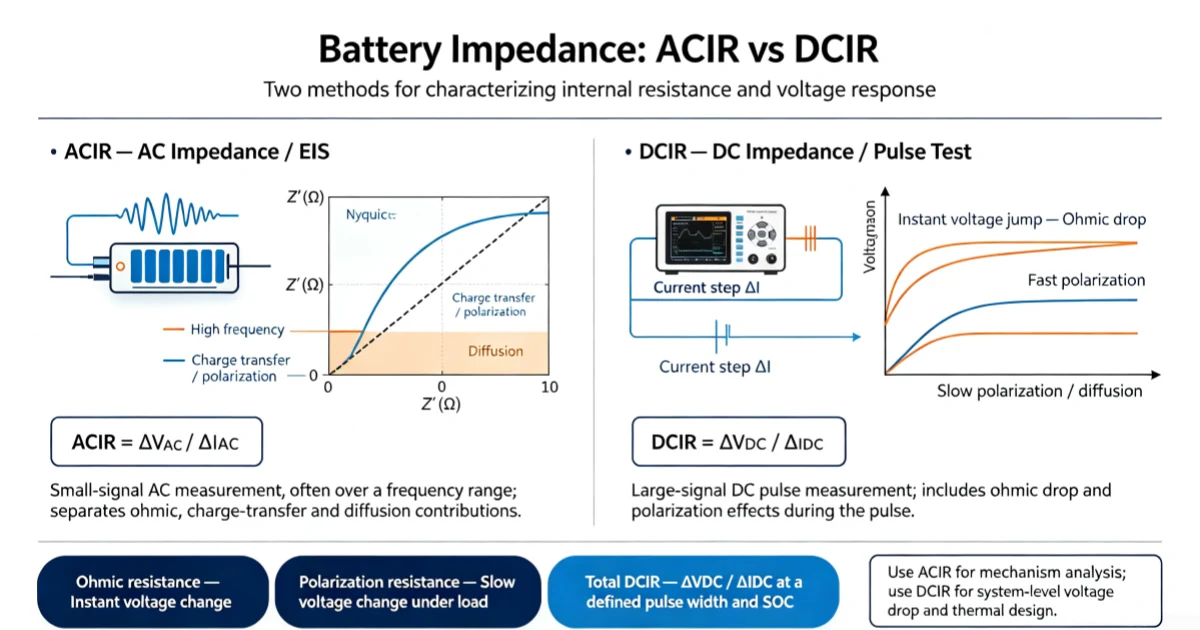
In electrochemical impedance spectroscopy, for example, different processes appear in different regions of a Nyquist plot. High-frequency behavior is mainly associated with ohmic resistance, while charge-transfer and diffusion processes become more significant at lower frequencies.
This is why the same battery cell can show different resistance values when measured using different methods.
2. ACIR vs. DCIR: Different Excitation, Different Results
ACIR — Alternating Current Internal Resistance
ACIR is measured by applying a small AC signal to the cell and measuring its voltage response.
A commonly used method applies an AC signal at 1 kHz and calculates the impedance from the voltage and current response. Four-terminal measurement can help reduce the influence of test-lead and contact resistance.
Because 1 kHz is a relatively high frequency, slower processes such as ion diffusion have less time to respond. As a result, ACIR is generally more sensitive to high-frequency impedance components, including contributions from the electrolyte, current collectors, tabs, welds, and connections.
However, 1 kHz ACIR should not simply be treated as pure ohmic resistance. The actual impedance response depends on the cell design, chemistry, capacity, test fixture, and measurement system.
One major advantage of ACIR is speed. It can be measured very quickly, making it suitable for incoming inspection, production-line testing, and high-volume cell sorting.
DCIR — Direct Current Internal Resistance
DCIR is measured by applying a DC current pulse and observing the resulting voltage change.
The basic calculation is:
R = ΔV / ΔI
However, DCIR is not a fixed resistance value independent of the test conditions. The result depends on:
- Pulse current
- Pulse duration
- SOC
- Temperature
- Sampling time
- Charge/discharge direction
- Cell condition and SOH
For example, a standardized DC resistance test may use a defined discharge current and measurement time. Different standards and applications can specify different procedures.
Immediately after a current step, the voltage response is strongly influenced by the ohmic component. As the pulse continues, polarization, charge-transfer, and diffusion effects increasingly contribute to the measured voltage change.
Therefore, a 1–10 second DCIR measurement generally includes more dynamic polarization effects than a 1 kHz ACIR measurement.
For many lithium-ion cells, DCIR measured under a specific pulse condition may be higher than 1 kHz ACIR. However, this is not a universal rule because the result depends strongly on the test conditions.
3. Why Can the Same Cell Show Different Resistance Values?
There are several main reasons.
1. Different Frequencies and Time Scales
A battery is not an ideal resistor. Its electrochemical system includes capacitive and other frequency-dependent behavior.
When the frequency or observation time changes, different electrochemical processes contribute to the measured impedance.
Therefore, ACIR and DCIR are not simply two instruments measuring exactly the same physical quantity in different ways. They characterize the cell’s response to different electrical excitations and time scales.
2. Test Leads, Contacts, and Fixtures
Measuring resistance at the milliohm level requires careful control of the measurement setup.
Probe position, contact pressure, contact area, cables, connectors, and fixture design can all affect the result.
A four-wire measurement helps minimize the influence of lead resistance, but it does not eliminate every measurement error.
For reliable results, the test fixture, contact method, calibration, and measurement procedure should remain consistent.
3. SOC and Temperature
Battery resistance changes significantly with operating conditions.
Temperature is particularly important. The same cell measured at 20°C and 25°C may produce different resistance values.
SOC can also affect the measured resistance.
Therefore, when comparing resistance data from different suppliers or test reports, you should compare not only the mΩ value but also the test temperature, SOC, test method, and measurement conditions.
4. Which Method Should You Use?
The appropriate method depends on what you want to know.
ACIR Is Suitable for:
- Production-line testing
- Incoming quality inspection
- Cell sorting and matching
- Fast screening of abnormal cells
- High-volume testing
ACIR is fast and highly repeatable when the test conditions are controlled.
DCIR and Pulse Testing Are Suitable for:
- Power performance evaluation
- Voltage-drop analysis
- High-current applications
- Equivalent-circuit model development
- Battery performance and SOH analysis
- Validation of pulse-power capability
DCIR is particularly useful when you want to understand how a cell responds to a real current pulse.
For example, in electric vehicles and energy storage systems, cells may experience high-current charging or discharging. Two cells can have similar ACIR values but show different voltage drops under a high-current pulse because their polarization characteristics are different.
Therefore, ACIR and DCIR are complementary rather than competing methods.
5. How to Compare Battery Resistance Data Correctly
If you are comparing battery cells from different suppliers, do not compare the mΩ values alone.
Try to keep the following conditions consistent:
- Measurement method: ACIR or DCIR
- AC frequency: such as 1 kHz
- SOC
- Temperature
- Current rate
- Pulse duration
- Sampling time
- Measurement equipment and fixture
For example, comparing an 18 mΩ ACIR value from one datasheet with a 22 mΩ DCIR value from another datasheet does not tell you which cell has lower internal resistance.
The measurement methods are different, so the numbers are not directly comparable.
6. Key Takeaways
- ACIR and DCIR are not right or wrong versions of the same measurement. They characterize battery resistance under different electrical conditions.
- Always check the test conditions. A resistance value without the test method, frequency or pulse duration, SOC, and temperature is incomplete.
- Four-wire measurement is important for milliohm-level testing, but contact position, pressure, fixture design, and calibration can still affect the result.
- For high-power applications, ACIR screening can be supplemented with DCIR or pulse testing to better evaluate dynamic voltage drop and power capability.
- Never directly compare an ACIR value with a DCIR value from another battery datasheet without checking the test conditions.
When evaluating lithium battery cells, the number of milliohms is only part of the story. The measurement method and test conditions are equally important.
For customized battery projects, LNC can help evaluate cell specifications based on the required voltage, capacity, current, power performance, dimensions, and application conditions.