In energy storage system operation, BMS strategy development, battery life assessment, asset management, and revenue analysis, SOC, SOH, DOD, and EOL are among the most important battery parameters.
Other key parameters include BOL, SOE, cycle life, and calendar life.
Understanding the difference between these parameters is important because they describe different aspects of battery operation, aging, and lifetime.
1. Key Battery Parameters
SOC — State of Charge
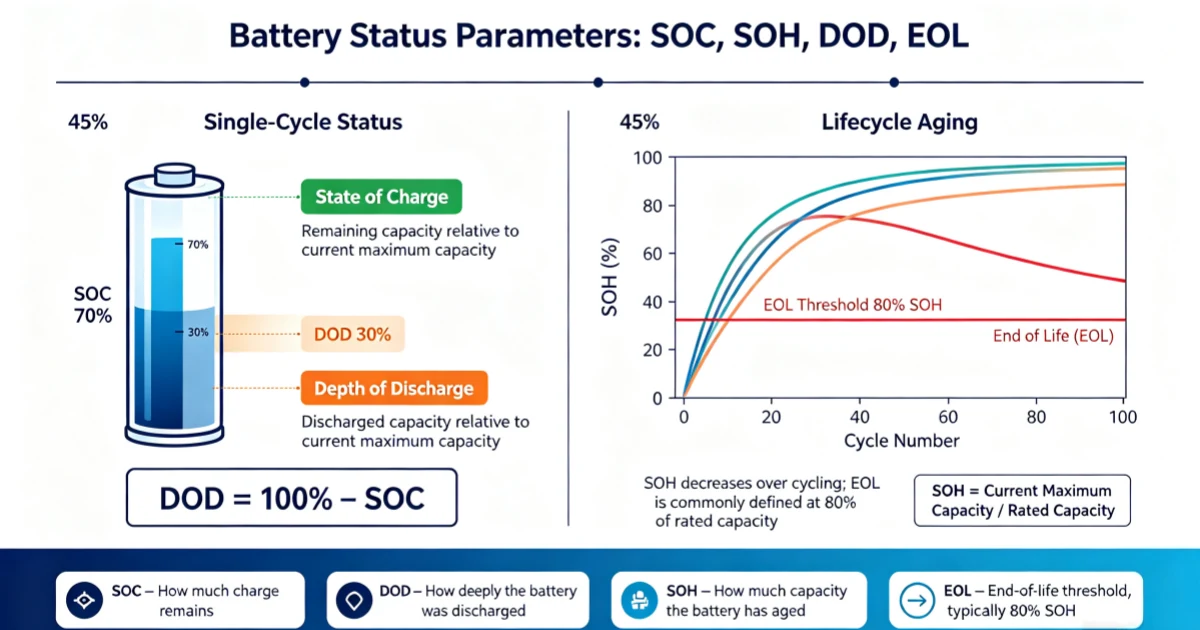
SOC indicates how much charge remains in the battery relative to its available capacity.
It is a real-time operating parameter that changes as the battery charges and discharges.
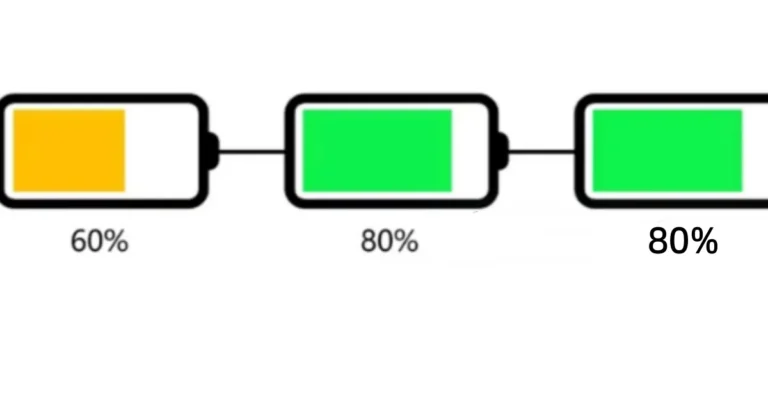
For example, an SOC of 80% means the battery has approximately 80% of its currently available charge remaining.
Engineering use: SOC is mainly used for battery control, charging and discharging strategies, and energy management.
DOD — Depth of Discharge
DOD indicates how much of the available battery capacity is discharged during a cycle.
For example, if a battery operates from 90% SOC down to 20% SOC, the DOD for that discharge is approximately 70%.
DOD is an operating condition rather than a measure of battery health. Deeper discharge generally places greater stress on the cells and can accelerate aging.
Engineering use: DOD is one of the key controllable factors affecting cycle aging and battery life.
SOH — State of Health
SOH indicates the current health or remaining performance of a battery compared with its original rated condition.
Capacity retention is commonly used as one of the main SOH indicators. Internal resistance and power capability can also be considered.
A new battery is generally considered to have an SOH close to 100%. An SOH of 80% is commonly used as a reference point for end-of-life evaluation, although the actual threshold depends on the application and manufacturer’s criteria.
Engineering use: SOH is used for battery health assessment, consistency evaluation, remaining-value assessment, and lifetime prediction.
EOL — End of Life
EOL is the point at which a battery no longer meets the performance requirements defined for its application.
It is not a real-time measurement but a predefined end-of-life criterion.
For many energy storage applications, 80% capacity retention is commonly used as an EOL reference. However, power capability, internal resistance, temperature rise, consistency, and other requirements may also be considered.
Engineering use: EOL defines the practical end of the battery’s first-life service and helps guide replacement, asset management, and second-life decisions.
BOL — Beginning of Life
BOL represents the initial condition of a new battery when it enters service.
It provides the baseline for evaluating capacity degradation, performance changes, and battery aging.
A new battery typically starts with an SOH close to 100%.
SOE — State of Energy
SOE indicates the amount of energy currently available from the battery, usually expressed in Wh or kWh.
Unlike SOC, which represents the remaining charge percentage, SOE focuses on the actual available energy.
SOE can take factors such as voltage, temperature, efficiency, and battery condition into account.
Engineering use: SOE is useful for energy scheduling, energy management, and estimating the amount of energy available for dispatch.
Cycle Life
Cycle life is the number of charge-discharge cycles a battery can complete before reaching its defined EOL condition under specified test conditions.
Cycle life cannot be meaningfully evaluated without considering factors such as DOD, temperature, charge/discharge rate, and operating voltage range.
Calendar Life
Calendar life refers to battery aging over time, even when the battery is not being actively cycled.
It is affected by factors such as temperature, storage SOC, cell chemistry, and material degradation.
Unlike cycle aging, calendar aging is primarily related to time and storage conditions.
2. How These Parameters Are Classified
These parameters can be divided into three main groups.
1. Real-Time State Parameters
SOC and SOE
These parameters describe the battery’s current operating state.
They can increase or decrease during normal operation and do not directly represent battery health.
A simple analogy is a person’s remaining energy or stamina.
2. Operating Condition Parameters
DOD
DOD describes how deeply the battery is discharged during operation.
It can be influenced by the battery management and energy dispatch strategy and is one of the important factors affecting future degradation.
A simple analogy is the intensity of a workout.
3. Aging and Lifetime Parameters
BOL, SOH, cycle life, calendar life, and EOL
These parameters describe battery aging, lifetime capability, or predefined lifetime boundaries.
Unlike SOC, they are not simply real-time charge levels. They are related to the long-term degradation of the battery.
3. How SOC, DOD, SOH, and EOL Are Related
SOC and DOD
SOC describes how much charge remains, while DOD describes how much capacity has been used during a discharge.
For a discharge from 90% SOC to 20% SOC:
DOD ≈ 90% − 20% = 70%
Therefore, the selected SOC operating window directly determines the DOD of each cycle.
DOD and SOH
DOD is closely related to battery aging.
Higher DOD generally means deeper cycling and can increase degradation per cycle. However, actual degradation also depends on temperature, charge/discharge rate, voltage range, chemistry, and other operating conditions.
Therefore, cycle life should always be evaluated together with its test conditions rather than by cycle count alone.
SOH and EOL
SOH is a continuously changing indicator of battery condition, while EOL is a predefined lifetime threshold.
A simplified battery life path is:
BOL → Cycling and Aging → SOH Decreases → EOL → Retirement or Second-Life Use
For example, if a project defines 80% capacity retention as its EOL criterion, the battery reaches EOL when its measured or estimated SOH reaches that threshold.
SOC, SOE, and SOH
These parameters should not be confused.
An old battery can still show 100% SOC after charging, while its actual available capacity may be significantly lower than that of a new battery.
- SOC: How much charge remains?
- SOE: How much energy is available?
- SOH: How healthy is the battery?
SOE can therefore provide a more useful estimate of actual available energy when battery aging is taken into account.
Cycle Life, Calendar Life, and EOL
A battery can reach EOL through different aging mechanisms.
Cycle aging: Frequent or deep charge-discharge cycling gradually reduces battery performance.
Calendar aging: The battery gradually degrades with time, even with relatively little cycling.
In real applications, the battery’s service life is determined by whichever aging mechanism causes it to reach the defined EOL condition first.
4. Key Takeaways
The relationship between these parameters can be summarized as:
BOL → DOD / Operating Conditions → Battery Aging → SOH Decline → EOL
At the same time:
- SOC indicates the current charge level.
- SOE indicates the available energy.
- DOD describes how deeply the battery is discharged.
- SOH indicates battery health and degradation.
- BOL defines the initial baseline.
- Cycle life describes aging under repeated cycling.
- Calendar life describes aging over time.
- EOL defines the end of the useful service life.
Understanding these parameters is essential for effective BMS strategy development, energy storage system operation, battery life prediction, and asset management.
For businesses developing customized energy storage systems, these parameters should be considered together with the required voltage, capacity, power, operating temperature, cycle requirements, and application conditions.
Looking for a customized energy storage battery solution? LNC provides OEM and ODM battery pack solutions for energy storage and other applications based on specific voltage, capacity, dimensions, current, and operating requirements.