Many people new to lithium batteries have the same questions: If a battery is rated 72V 60Ah, how much energy does it actually store? What is the difference between Ah and Wh? Why are some batteries rated in Ah while others use Wh?
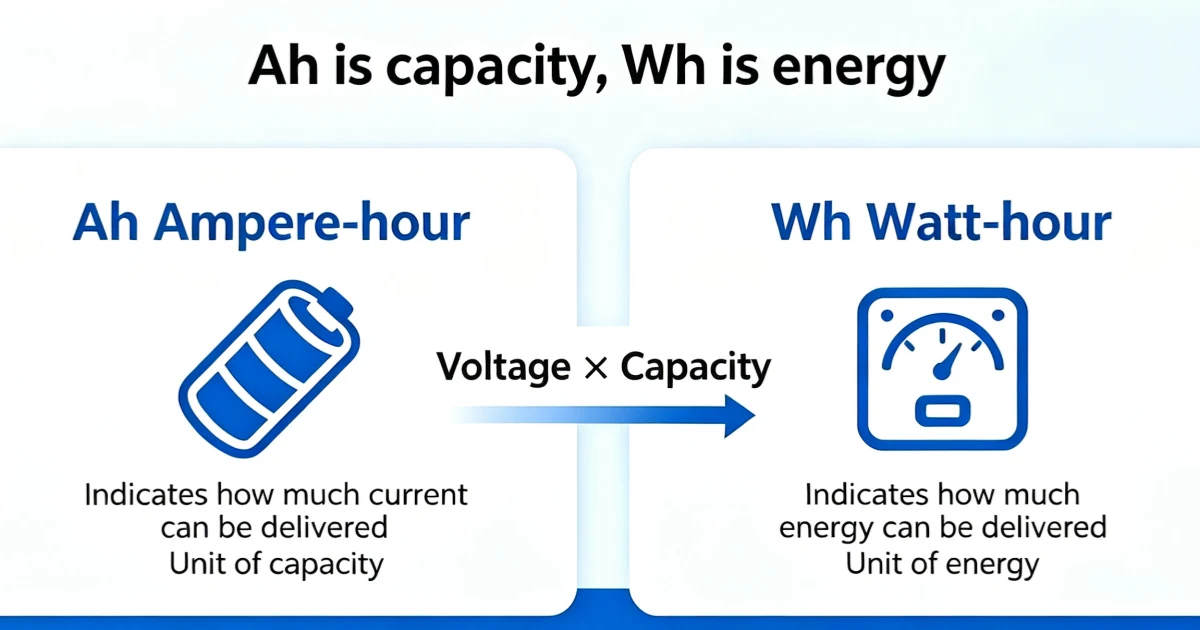
The key is simple: Ah measures battery capacity, while Wh measures energy.
1. What Are Ah and Wh?
Ah (Ampere-hours)
Ah is a unit of battery capacity. It indicates how much electrical charge a battery can deliver over time.
For example, a 60Ah battery could theoretically deliver:
- 1A for 60 hours
- 10A for 6 hours
Actual performance depends on factors such as discharge current, temperature, battery chemistry, and cutoff voltage.
Wh (Watt-hours)
Wh measures the amount of energy stored in a battery.
It is also easier to use when comparing the energy capacity of batteries with different voltages.
For example, a 1,000Wh battery theoretically has enough energy to power a 1,000W device for about one hour.
In household electricity, 1 kWh = 1,000Wh, commonly referred to as one unit of electricity.
2. What Is the Difference Between Ah and Wh?
| Item | Ah (Ampere-hours) | Wh (Watt-hours) |
|---|---|---|
| Measures | Electrical charge capacity | Energy |
| Related to voltage? | No | Yes |
| Formula | Current × Time | Voltage × Ah |
| Useful for comparing different voltages? | Limited | Yes |
A simple way to understand it is:
Ah tells you how much electrical charge the battery can deliver, while Wh tells you how much energy the battery contains.
For example:
- 12V 100Ah battery: 12 × 100 = 1,200Wh = 1.2kWh
- 48V 50Ah battery: 48 × 50 = 2,400Wh = 2.4kWh
Although the 12V battery has a higher Ah rating, it stores only half as much energy as the 48V battery.
That’s why you should not compare battery capacity by Ah alone when the voltages are different.
3. How to Calculate Lithium Battery Capacity
1. Calculate Wh from Voltage and Ah
The basic formula is:
Wh = Voltage (V) × Capacity (Ah)
For example:
- 72V 50Ah = 72 × 50 = 3,600Wh = 3.6kWh
- 60V 30Ah = 60 × 30 = 1,800Wh = 1.8kWh
- 48V 20Ah = 48 × 20 = 960Wh = 0.96kWh
Use the battery’s nominal voltage for this calculation, rather than its fully charged or cutoff voltage.
For example, a typical NMC lithium-ion cell has a nominal voltage of about 3.7V, while a LiFePO4 cell is about 3.2V.
2. Calculate Ah from Wh and Voltage
If you know the energy capacity and voltage, use:
Ah = Wh ÷ Voltage (V)
For example, if a battery is rated at 3,600Wh and 72V:
3,600 ÷ 72 = 50Ah
So the battery capacity is 72V 50Ah.
4. Key Points to Remember
- Don’t compare batteries by Ah alone. When voltage is different, calculate Wh to compare their actual energy capacity.
- Always check the voltage when a battery is only rated in Ah or Wh. This helps you understand the actual battery capacity.
- For electric vehicle range, Wh or kWh is more useful than Ah alone. A higher Wh rating generally means more available energy under comparable conditions.
- When designing a battery pack, calculate the required energy first. Then determine the system voltage, series configuration, and parallel configuration based on the application and required current.
Understanding the difference between Ah and Wh makes it much easier to compare lithium battery specifications and select the right battery for your application.
Need a customized lithium battery pack? LNC provides OEM and ODM battery pack solutions based on your required voltage, capacity, dimensions, current, and application.