Introduction
The rapid growth of renewable energy, solar power, and battery energy storage systems (BESS) has increased demand for reliable lithium battery PACK solutions.
A high-quality energy storage battery PACK is not simply a combination of battery cells. It requires a complete manufacturing process that ensures electrical performance, mechanical stability, thermal safety, and long-term reliability.
A typical prismatic battery module and PACK production process includes cell inspection, sorting, module assembly, busbar welding, BMS integration, thermal management, and final testing.
This article explains the key steps involved in prismatic lithium battery module PACK manufacturing and the quality-control factors that determine battery system reliability.
1. Battery Cell Inspection and Sorting
Battery cells are the foundation of every energy storage battery system.
Before assembly, each prismatic cell needs to be inspected and tested.
Common inspection items include:
- Cell voltage
- Internal resistance
- Capacity consistency
- Appearance condition
- Barcode or QR code tracking
Cells with abnormal electrical parameters are removed before entering the module assembly process.
Cell sorting is important because battery cells connected in the same module should have similar characteristics.
Good cell matching helps improve:
- Battery cycle life
- Energy efficiency
- System stability
- BMS balancing performance
For large-scale energy storage systems, accurate cell testing and traceability are essential for long-term reliability.
2. Prismatic Cell Stacking and Module Assembly
After cell inspection, qualified cells are assembled into battery modules.
The module structure usually includes:
- Prismatic lithium battery cells
- Insulation materials
- End plates
- Cell separators
- Compression structures
- Busbars
During assembly, accurate positioning is critical.
Incorrect cell alignment may affect:
- Electrical connection
- Welding quality
- Module dimensions
- Thermal management
- Mechanical strength
A well-designed battery module must handle vibration, thermal expansion, and long-term operating stress.
3. Busbar Installation and Laser Welding
The busbar connects multiple battery cells to create the required series and parallel configuration.
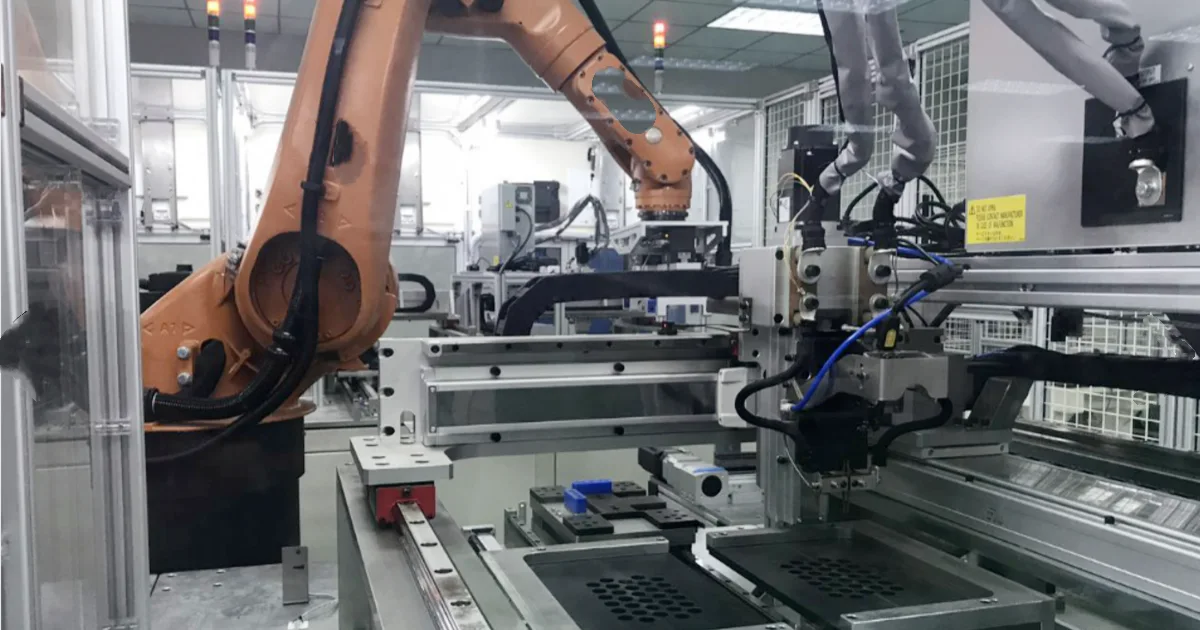
After busbar installation, automated equipment is commonly used for laser welding.
Laser welding is widely adopted in battery manufacturing because it provides:
- High precision
- Strong electrical connection
- Low heat impact
- Excellent repeatability
The welding process must be carefully controlled to ensure:
- Correct welding position
- Stable electrical resistance
- Reliable mechanical strength
- Minimal thermal damage to battery cells
After welding, inspection may include:
- Weld appearance checking
- Position inspection
- Electrical resistance testing
- Automated vision inspection
Reliable welding is critical because poor electrical connections can reduce battery performance and create safety risks.
4. Battery Management System (BMS/BMU) Integration
A battery module requires an intelligent monitoring and protection system.
The Battery Management System (BMS) or Battery Management Unit (BMU) monitors important parameters such as:
- Cell voltage
- Temperature
- Current
- Battery status
- Fault conditions
Typical BMS functions include:
- Overcharge protection
- Over-discharge protection
- Overcurrent protection
- Temperature monitoring
- Cell balancing
- State-of-charge estimation
A properly designed BMS improves battery safety, performance, and service life.
5. Thermal Management and Mechanical Protection
Thermal management is an important part of energy storage battery PACK design.
Battery performance and lifetime can be affected by temperature differences between cells.
Depending on the application, battery PACKs may use:
- Air cooling
- Liquid cooling
- Cooling plates
- Thermal interface materials
- Temperature sensors
A complete PACK design also includes mechanical protection such as:
- Enclosures
- Structural supports
- Insulation components
- Shock protection
The goal is to maintain stable operation under different environmental conditions.
6. Battery PACK Assembly and Final Testing
After module assembly, the battery module is integrated into the final PACK.
The PACK assembly process may include:
- Module installation
- BMS connection
- Wiring harness installation
- Cooling system integration
- High-voltage connector assembly
- Enclosure installation
Before delivery, each battery PACK should undergo comprehensive testing.
Typical tests include:
Electrical Testing
- Voltage measurement
- Current testing
- Insulation resistance testing
Functional Testing
- BMS communication
- Protection function verification
- Temperature monitoring
- Charging and discharging performance
Quality Inspection
- Appearance inspection
- Assembly verification
- Safety inspection
Only qualified battery PACKs should enter the market.
7. Quality Control in Battery PACK Manufacturing
Battery quality should be controlled throughout the entire production process, not only during final inspection.
Important quality-control points include:
| Manufacturing Stage | Key Inspection |
|---|---|
| Cell inspection | Voltage, resistance, appearance |
| Cell sorting | Consistency matching |
| Module assembly | Position accuracy |
| Welding process | Weld quality and resistance |
| BMS installation | Communication and protection |
| Final PACK testing | Electrical and safety performance |
A complete quality-control system improves:
- Product reliability
- Manufacturing consistency
- Safety performance
- Customer confidence
8. Importance of Traceability in Battery Manufacturing
Modern battery manufacturing requires complete production traceability.
Through barcode and production management systems, manufacturers can track:
Battery Cell → Module → PACK → Production Data
Traceability allows manufacturers to identify:
- Cell production information
- Testing results
- Assembly history
- Welding parameters
- Final product records
For large energy storage projects, traceability is essential for quality analysis and after-sales support.
9. Applications of Prismatic Battery PACK Solutions
Prismatic lithium battery PACKs are widely used in:
- Solar energy storage systems
- Commercial and industrial energy storage
- Backup power systems
- Electric vehicles
- Low-speed vehicles
- Industrial equipment
- Renewable energy applications
Different applications require different battery designs based on:
- Voltage
- Capacity
- Current demand
- Operating temperature
- Space limitations
- Communication requirements
Conclusion
A reliable prismatic battery module PACK is created through the combination of high-quality battery cells, precise manufacturing processes, advanced BMS technology, effective thermal management, and strict quality control.
The complete manufacturing process includes:
- Battery cell testing and sorting
- Cell stacking and module assembly
- Busbar installation and welding
- BMS/BMU integration
- Thermal management installation
- PACK assembly
- Electrical and safety testing
As demand for renewable energy and energy storage continues to grow, battery PACK manufacturing will move toward higher automation, better traceability, and smarter quality management.
At LNC Battery, we provide customized lithium battery cells, LiFePO4 battery solutions, cylindrical battery packs, and energy storage battery solutions for industrial, commercial, and renewable energy applications.
Contact us for customized battery solutions based on your voltage, capacity, current, and application requirements.