Why Lithium-Ion Battery Voltage Drops Too Much: The Real Causes Nobody Talks About
Voltage drop in lithium-ion cells sounds simple until you dig into it. A cell reads 4.2V at rest, then plummets to 3.4V the moment you pull current. Or worse — it holds up fine for the first few minutes, then collapses fast. Most people blame the battery. Few stop to ask what is actually causing the drop inside the cell.
The answer is almost never one thing. Voltage sag comes from a stack of overlapping mechanisms, and each one leaves a different fingerprint on the data. Getting this right matters whether you are designing a pack for an electric vehicle or debugging a power tool that dies mid-cut.
The Three Layers of Voltage Drop You Need to Understand
Ohmic Loss: The Instant Drop
The moment current flows, voltage falls. This is pure resistance — no chemistry involved, just physics. Every connection point, every current collector, every electrode coating, every separator contributes. In a healthy cell, this ohmic drop stays small, typically under 50 millivolts at 1C. But it adds up fast when the current climbs.
The formula is brutal in its simplicity: V equals I times R. Double the current, double the drop. This is why a cell that tests fine at 0.5C can look terrible at 3C. The resistance did not change. The current did.
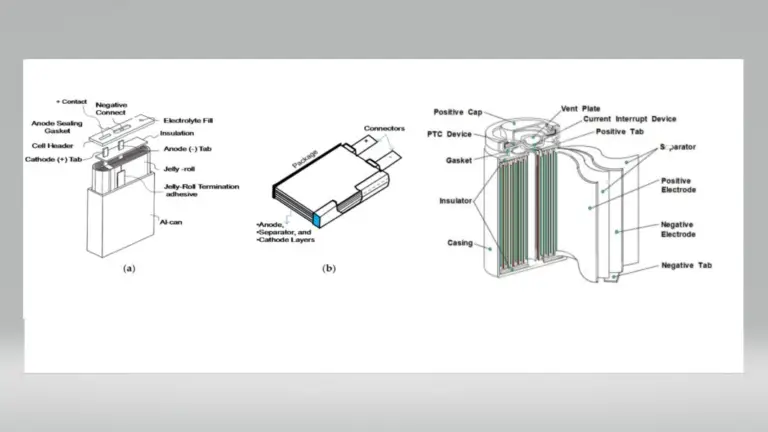
Ohmic resistance includes electrolyte ionic resistance, contact resistance between electrode and current collector, and any resistance from tabs, welds, and external wiring. In a pack, the protection board alone can eat 50 to 150 millivolts under load. MOSFETs, sampling resistors, solder joints — every milliohm counts.
Polarization: The Slower, Bigger Killer
Beyond ohmic loss, polarization eats voltage in three distinct ways, each operating on a different timescale.
Electrochemical polarization happens almost instantly. When current hits the electrode surface, the reaction cannot keep pace. Charge builds up at the interface, and voltage sags. This recovers in microseconds once the load is removed.
Concentration polarization is slower. Lithium ions diffuse through the electrolyte and into the active material at a finite rate. At high currents, ions cannot reach the reaction sites fast enough. The concentration gradient steepens, and voltage drops further. This one takes seconds to recover.
The combined effect shows up clearly on a discharge curve. The initial voltage drop is ohmic plus electrochemical polarization. The gradual sag during discharge is concentration polarization dominating. And at the very end, when voltage collapses toward cutoff, that is diffusion hitting its wall.
Activation Overpotential: The Hidden Tax
This one gets ignored a lot. Even when a cell is at rest, the voltage you measure is not the true thermodynamic voltage. It is offset by activation overpotential — the energy barrier the reaction must overcome to proceed. At low temperatures, this barrier grows. The same cell that reads 3.7V at 25 degrees Celsius might read 3.4V at minus 10 degrees, even with zero load. That is not a fault. That is chemistry.
Temperature: The Single Biggest Variable Most People Ignore
Cold does not just slow things down. It changes the entire voltage profile.
At low temperatures, electrolyte viscosity climbs, ion mobility drops, and charge transfer kinetics slow to a crawl. The discharge curve at minus 15 degrees Celsius looks almost linear compared to the flat plateau at room temperature. In one test, a cell delivered only 29.87 amp-hours at minus 15 degrees versus 37.52 amp-hours at 25 degrees under the same 1C discharge. That is a 20 percent capacity loss from temperature alone, and it shows up as a steep voltage drop under any meaningful load.
High temperature does the opposite in the short term — voltage stays higher, internal resistance drops, and the cell feels stronger. But the long-term cost is brutal. Elevated temperatures accelerate electrolyte decomposition, SEI growth, and transition metal dissolution. The cell looks great for the first fifty cycles, then the voltage drop accelerates as internal resistance climbs. What you gain in the short run, you lose threefold over the life of the pack.
The sweet spot for most chemistries sits between 25 and 40 degrees Celsius. Outside that band, voltage drop worsens in both directions — just for completely different reasons.
Internal Resistance Growth: The Aging Problem
A fresh cell has low internal resistance. An old cell does not. This is the single most common reason voltage drop gets worse over time.
Every cycle thickens the SEI layer on the anode. This film is necessary — it protects the anode from electrolyte decomposition. But it is also resistive. As it grows, charge transfer resistance climbs. The mid-frequency semicircle on a Nyquist plot expands cycle after cycle. After 500 cycles, the resistance at 100 hertz can be double what it was at birth.
Electrolyte degradation makes this worse. Decomposition products accumulate at the electrode-electrolyte interface, increasing impedance. In high-voltage cathodes like NMC811, the electrolyte oxidizes at the upper cutoff, generating resistive byproducts that coat the cathode surface. The result is a cell that cannot deliver current without significant voltage sag, even if its capacity has not dropped much yet.
Cathode structural changes contribute too. Repeated lithium insertion and extraction cause lattice strain, particle cracking, and phase transitions. Cracked particles lose electrical contact with the conductive network. The effective resistance rises, and voltage under load drops accordingly.
Micro-Short Circuits: The Silent Voltage Killer
This is the one that catches people off guard. A cell can lose voltage rapidly in storage, even with zero external load, and the culprit is often an internal micro-short.
Manufacturing defects cause most of these. A burr on the current collector punches through the separator. A coating defect lets active material bridge the gap. A large particle in the slurry creates a local pressure point that tears the separator during vacuum formation. Any of these creates a tiny conductive path between anode and cathode.
The current through a micro-short is small — not enough to trigger thermal runaway. But it is enough to drain the cell over hours or days. The voltage drops steadily, sometimes several hundred millivolts per day at 60 degrees Celsius. The cell looks dead, but if you could isolate the short, the capacity might still be there.
Detecting this requires looking at self-discharge rate. A healthy cell loses 2 to 5 percent per month. A cell with a micro-short can lose 10 to 20 percent in a week. The voltage drop is not a load problem. It is a leak.
Over-Discharge and the Voltage Cliff
Pushing a cell below its minimum voltage does not just waste capacity. It permanently damages the internal chemistry.
Below 2.5 volts per cell, irreversible reactions begin. Copper from the anode current collector starts dissolving into the electrolyte. The SEI layer on the anode breaks down and reforms unevenly, consuming more lithium in the process. When you recharge, the voltage curve looks wrong — the plateau is shorter, the resistance is higher, and the voltage drops faster under any load.
The damage is cumulative. One deep discharge might cost 5 percent of capacity. Ten deep discharges can cost 25 percent or more. And the voltage drop under load gets worse with each cycle because the internal resistance keeps climbing.
This is why a BMS cutoff at 2.8V is not just a safety feature — it is a longevity feature. Every tenth of a volt you save at the bottom extends the useful life of the cell measurably.
Electrode and Electrolyte Side Reactions: The Slow Drain
Even in a perfectly manufactured cell, side reactions consume lithium and increase resistance over time.
At high voltages, the electrolyte oxidizes on the cathode surface. This generates gas, resistive films, and transition metal ions that migrate to the anode and poison the SEI. At low voltages, the electrolyte reduces on the anode, thickening the SEI and trapping lithium.
These reactions are slow at room temperature but accelerate sharply above 45 degrees Celsius. A cell stored at 55 degrees for 90 days can see its SEI thickness grow to 164 percent of the initial value, with active lithium loss accounting for over 70 percent of the capacity fade. The voltage drop under load follows the same trajectory — it gets worse because the cell has less usable lithium and higher resistance.
Additive depletion makes this worse over time. Fluoroethylene carbonate and vinylene carbonate are designed to form a stable, inorganic-rich SEI. But once these additives are consumed, the SEI switches to organic-dominated growth, which is porous, unstable, and keeps expanding. The voltage drop accelerates because the cell is now losing lithium faster and building resistance simultaneously.
What This Means for Diagnosing Voltage Drop in the Real World
If your cell voltage sags under load, do not just replace it. Measure the resistance at 1000 hertz, 100 hertz, and 10 hertz. The 1000 hertz value tells you about ohmic health. The 100 hertz value tracks SEI growth. The 10 hertz value reveals diffusion limitations. Compare these against a fresh cell from the same batch, and you will know exactly which mechanism is driving the drop.
Check the self-discharge rate. If the cell loses more than 5 percent per month at rest, look for micro-shorts before you blame the chemistry.
Check the temperature history. A cell that spent time above 45 degrees will show accelerated resistance growth regardless of how gently it was cycled.
And check the voltage curve shape. A flat plateau that has shortened points to cathode degradation. A sagging curve with a steep tail points to diffusion problems or anode damage. A curve that collapses early points to capacity loss from lithium consumption — most likely SEI growth or side reactions.
Voltage drop is a symptom, not a diagnosis. The real question is always what is causing it, and the answer is almost always hidden in the impedance spectrum, not the voltage number itself.