Active and Passive Balancing of lithium ion Battery BMS
01 Passive balancing
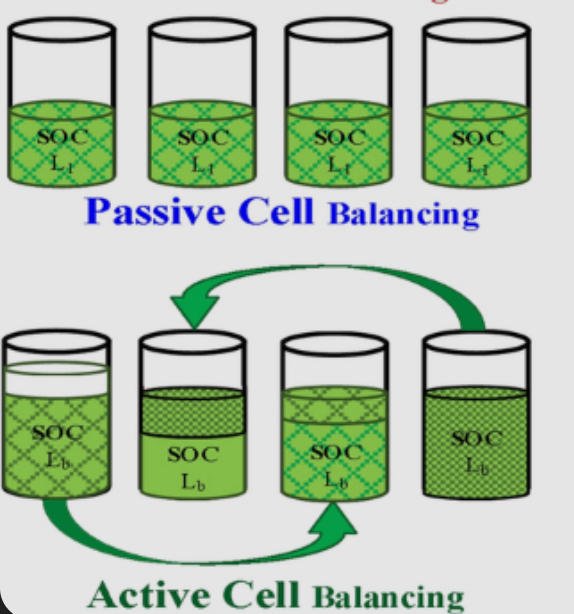
Passive Balancing typically discharges the higher-voltage batteries through resistors, releasing the excess energy as heat to allow more charging time for the other batteries. This process causes the overall system’s energy to be limited by the battery with the smallest capacity. During charging, lithium batteries usually have a charge protection voltage limit. Once a string of batteries reaches this voltage limit, the battery protection board will cut off the charging circuit and stop charging. Therefore, the advantages of passive balancing are its low cost and simple circuit design. However, its disadvantages include balancing based on the battery with the lowest remaining charge, which does not increase the capacity of the battery with lower charge, and the fact that 100% of the balancing energy is wasted in the form of heat. Lithium battery protection boards generally include overcharge protection to prevent the battery from overcharging.
02 Active Balancing
Active balancing achieves balancing through energy transfer, with high efficiency and low loss. Different manufacturers use different methods, and the balancing current varies from 1 to 10A. Passive balancing is suitable for applications with small-capacity, low-series lithium battery packs, while active balancing is suitable for applications with high-series, large-capacity power lithium battery packs. For BMS, in addition to the balancing function being very important, the underlying balancing strategy is even more crucial.