Lithium-Ion Battery High-Temperature Stability Analysis — Why Heat Is the Silent Killer of Your Cells
Every lithium-ion battery has a temperature ceiling. Cross it, and you do not just lose capacity — you invite thermal runaway, gas generation, and in the worst cases, fire or explosion. As global extreme heat events become more frequent and electric vehicles proliferate in hot climates, understanding how these cells behave under thermal stress is no longer an academic exercise. It is an engineering necessity.
The data is stark. Research grounded in the Arrhenius equation (k = Ae−Ea/RT) shows that for every 10°C rise in temperature, side reaction rates roughly double. Above 45°C, the internal chemical equilibrium starts to collapse. Above 60°C, degradation accelerates dramatically even without any abuse. This is not a gradual decline. It is a cascade.
What Actually Happens Inside the Cell When Temperature Climbs
Heat does not attack a lithium-ion battery uniformly. It triggers a chain reaction, layer by layer, starting from the most vulnerable components and spreading inward.
The SEI Membrane — The First Domino to Fall
The solid electrolyte interphase (SEI) membrane on the graphite anode is the cell’s first line of defense. It is also the first thing to go. Between 90°C and 120°C, the SEI layer begins to decompose and crack. This is not a minor event. Every time the SEI breaks down, it consumes active lithium ions to rebuild itself. Research shows that after cycling at 45°C, the SEI thickness can balloon from an initial etch time of 18 seconds to over 300 seconds. The lithium lost to this reconstruction accounts for more than 80% of capacity fade.
Once the SEI fails above 120°C, the embedded lithium in graphite is exposed directly to the electrolyte. The result is an immediate exothermic reaction — the cell starts generating its own heat from the inside out.
Electrolyte Decomposition — The Fuel for the Fire
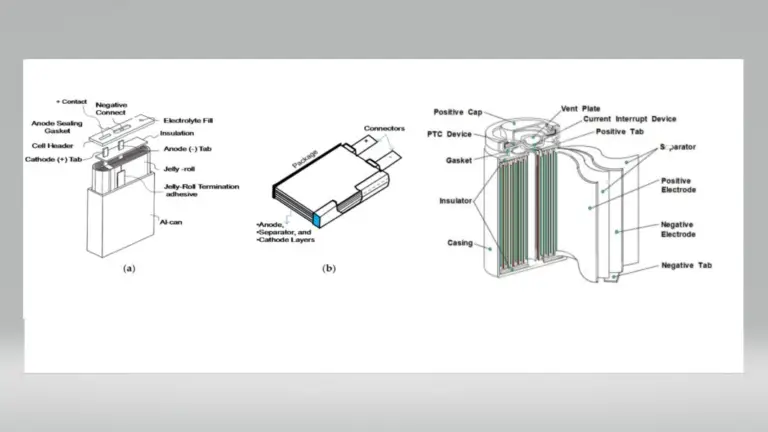
The electrolyte, typically a mixture of alkyl carbonate solvents with LiPF6 salt, is thermally fragile. At 60°C, the decomposition rate of the electrolyte is roughly 100 times higher than at room temperature. LiPF6 breaks down into corrosive HF and PF5. The carbonate solvents — EC, DEC, DMC — crack into CO2, C2H4, and other gases. These gases increase internal pressure. The decomposition products coat the separator, forming a blockage that chokes off ion transport.
DMC-heavy electrolyte formulations are notably less stable than DEC-based ones. The choice of solvent is not a minor formulation detail. It is a stability decision.
Cathode Breakdown — Where the Real Damage Begins
The cathode is where the most violent reactions occur. Layered oxide materials such as NCM (nickel-cobalt-manganese) are particularly vulnerable. At elevated temperatures, the crystal structure undergoes phase transitions. Nickel-rich compositions are the least stable — the higher the nickel content, the lower the thermal decomposition onset temperature. NCM811 starts releasing oxygen at relatively low temperatures compared to NCM111 or NCM523.
That released oxygen does not just sit there. It reacts with the flammable electrolyte in a strongly exothermic process. Between 180°C and 500°C, the cathode-electrolyte reaction becomes violent, producing large volumes of gas and intense heat. For LiCoO2, the spontaneous reaction temperature can be as low as 170°C. For LiMn2O4, the onset sits around 160°C with a structural phase change.
Transition metals — nickel, cobalt, manganese — dissolve from the cathode at high temperature and migrate to the anode. There, they deposit on the graphite surface like debris clogging a drain, blocking lithium-ion pathways and accelerating capacity loss. Even LFP, often praised for its thermal stability, is not immune. TOF-SIMS analysis has detected iron migration into the anode region under prolonged high-temperature storage.
The Thermal Runaway Cascade — A Step-by-Step Meltdown
Thermal runaway is not a single event. It is a sequence. Understanding the sequence is the only way to design effective protection.
Stage One: SEI Collapse and Anode Exposure (90–120°C)
The SEI membrane decomposes. The anode is now naked to the electrolyte. Exothermic reactions begin. The cell temperature starts climbing on its own.
Stage Two: Separator Failure (130°C+)
Polyolefin separators begin to shrink and melt around 130°C. As they close their pores, internal resistance spikes. If the separator fully melts, the anode and cathode make direct contact. Internal short circuit. Massive Joule heating in milliseconds.
Stage Three: Cathode-Electrolyte Inferno (180–500°C)
The cathode releases oxygen. The oxygen ignites the electrolyte. Gas generation goes into overdrive — CO2, C2H4, and various organic vapors fill the cell. Pressure builds. The cell vents, sprays flammable material, and if the temperature climbs further, it ignites.
Stage Four: Structural Collapse (500°C+)
At around 660°C, the aluminum current collector melts. The cell structure disintegrates entirely. At this point, there is no recovery.
This cascade explains why a single cell thermal runaway can propagate to an entire battery pack. One cell vents hot gas and flame, and neighboring cells follow like dominoes.
How Different Chemistries Handle Heat
Not all lithium-ion batteries are created equal when it comes to thermal stability. The chemistry you choose determines your safety margin.
NCM vs LFP vs LCO — A Clear Hierarchy
LiCoO2 (LCO) has the lowest thermal stability among common cathodes. Overcharge testing shows that LCO cells can explode when charged to 10V at 2C rate. LiMn2O4 (LMO) handles overcharge far better — the same test produces only swelling, no fire or explosion. This is why manganese-rich chemistries are inherently safer under abuse.
NCM materials follow a clear trend: the more nickel, the less stable. NCM811 is the most energy-dense and the most thermally fragile. NCM111 is the most stable but stores the least energy. NCM523 and NCM622 sit in between. This trade-off between energy density and thermal stability is the central tension in modern battery design.
LFP (LiFePO4) offers better thermal stability than most NCM variants, but it is not invincible. Long-term high-temperature storage still causes transition metal dissolution and SEI degradation. The myth that LFP cannot catch fire is dangerous and wrong.
The Role of Nickel Content in High-Temperature Storage
High-nickel NCM811 cells stored at 60°C in a fully charged state show dramatic degradation within roughly 180 days. XRD analysis reveals that the cathode surface develops a rock-salt phase — an electrochemically inactive layer that increases impedance. The (104)/(003) peak intensity ratio climbs, indicating lithium loss from the cathode structure. Simultaneously, dissolved nickel and manganese deposit on the anode, tearing apart the SEI and consuming active lithium.
The result is a cell that looks intact on the outside but has lost significant capacity and internal resistance on the inside.
Capacity Fade Mechanisms Under Sustained Heat
High-temperature cycling and high-temperature storage attack the cell through different but overlapping pathways.
Calendar Aging vs Cycle Aging at Elevated Temperature
Below 60°C, calendar aging dominates. The cell loses capacity even when sitting idle. The primary culprit is SEI growth and transition metal crosstalk. Above 60°C, the degradation rate jumps sharply. Electrochemical impedance spectroscopy (EIS) data from cells cycled at 55°C shows that the anode charge-transfer resistance (Rct) increases steadily with cycle count, while the cathode Rct actually decreases slightly due to gradual activation. The net effect is rising polarization, voltage platform drift, and capacity loss.
For cells stored at 80°C, the cathode resistance component (R2) can grow to roughly 10 times that of a fresh cell. The anode resistance barely changes. This tells you exactly where the damage is concentrating: the cathode is taking the beating, not the anode.
Impedance Growth and Power Loss
As temperature climbs, so does internal resistance. The electrolyte thickens, the SEI thickens, and rock-salt phases accumulate on cathode particles. All of this increases ohmic polarization. The cell delivers less power, charges slower, and heats up more during operation — which accelerates the degradation further. It is a vicious loop.
Mitigation Strategies That Actually Work
You cannot eliminate heat. But you can manage it.
Thermal Management Systems — Non-Negotiable
Modern electric vehicles rely on liquid cooling or advanced air cooling to keep cell temperatures below 45°C. Data shows that vehicles equipped with proper thermal management systems see roughly 35% less performance degradation in 40–50°C ambient conditions compared to those without. The thermal management system is not a luxury feature. It is the difference between a battery that lasts five years and one that dies in two.
Material-Level Approaches
Surface coating of cathode particles — with aluminum oxide, lithium niobate, or polymer-ceramic composites — suppresses transition metal dissolution and stabilizes the cathode-electrolyte interface. Doping the cathode lattice with elements like aluminum or titanium improves structural stability at high temperature. For the anode, artificial SEI layers and silicon-carbon composites can improve thermal conductivity and reduce hotspot formation.
Built-In Heating for Cold, But Also Self-Regulation for Heat
Recent research from Penn State proposes integrating a 10-micron nickel foil heater inside the cell, powered by the battery itself. This allows the cell to maintain optimal temperature in extreme cold, but the same architecture can be repurposed for thermal regulation — preventing the cell from ever reaching dangerous temperatures in the first place. The operating window expands from the conventional -30°C to 45°C range to -50°C to 75°C.
The Bottom Line on High-Temperature Operation
Lithium-ion batteries do not tolerate heat the way consumers assume they do. Every 10°C above 25°C cuts into cycle life. Above 45°C, the degradation becomes nonlinear. Above 60°C, you are in dangerous territory even without any external abuse. The SEI membrane, the electrolyte, the separator, and the cathode all have thermal limits — and they fail in sequence, not simultaneously.
The cells that survive high-temperature operation are not lucky. They are engineered. Through material selection, electrode design, electrolyte formulation, and active thermal management. If you are designing a system that will operate in hot climates, treating thermal stability as an afterthought is not an option. It is the foundation everything else is built on.